
What Should an Aftermarket AC Compressor Clutch Supplier Solve for Distributors?
An aftermarket AC compressor clutch supplier should help a professional buyer solve three connected problems: identify the correct replacement part, maintain an inventory that reflects real market demand, and reproduce the approved specification when that part is reordered. A broad catalogue has little commercial value if similar-looking clutches are difficult to distinguish or the product received in a later shipment differs from the originally approved configuration.
This matters because an automotive compressor clutch is not identified reliably by vehicle name or appearance alone. Depending on the compressor and application, buyers may need to check the compressor reference, pulley diameter, belt-groove configuration, coil voltage, bearing specification, hub design, connector and other mounting details. KASEN's automotive AC compressor clutch selection guide likewise identifies these as important fitment factors for aftermarket buyers.The objective is therefore not to source the largest possible quantity of clutches; it is to build replacement SKUs that your sales team, warehouse and customers can identify consistently.
Who Needs a Dedicated Aftermarket Clutch Supply Program?
The strongest fit is usually importers, automotive AC parts distributors, regional wholesalers, compressor repair businesses, workshop supply networks and private-label aftermarket brands. An importer may need a range broad enough to serve different compressor applications while controlling container or shipment value. A distributor needs individual SKUs that technicians can reorder without repeating the entire identification process. A repair-network supplier may concentrate on fewer references but require reliable replenishment because an unavailable clutch can delay a workshop job.
Not every purchase requires a structured aftermarket program. A workshop buying one replacement for one identified compressor may need only a correct part and technical confirmation. Likewise, when the compressor itself has internal damage, sourcing a clutch alone may not solve the repair problem.An aftermarket AC compressor clutch supplier should therefore distinguish between supplying a component and determining the correct repair. KASEN also supplies complete automotive AC compressors, allowing buyers to evaluate the appropriate product category when their purchasing requirement extends beyond the clutch.
Build the Replacement Range From Actual Market Demand
Aftermarket product planning works better when the catalogue reflects demand rather than simply mirroring every model a factory can offer. Start with compressor numbers, previous enquiries, sales records, workshop requests and regional vehicle populations already known to your business. Separate references into established stock items, controlled trial items and special-order items. A high-turnover reference may justify regular inventory; an uncertain application should first go through fitment and sample confirmation.
For distributors entering a new market, avoid buying the same quantity of every model just to present a large catalogue. The earlier KASEN AC compressor clutch wholesale guide recommends building inventory around established references, trial references and special-order demand rather than treating every SKU equally. That approach is particularly useful when the buyer must balance product coverage against slow-moving inventory.
An aftermarket range can also be organized by practical application groups—passenger vehicles, commercial vehicles, buses or other verified compressor applications—but the application label should remain connected to the actual product reference. KASEN states that it supplies automotive AC parts to the global aftermarket and domestic OEM customers and invites buyers to discuss custom production using drawings or OEM numbers. About KASEN provides the broader company background.
Use a Fitment Record Before Approving a New SKU
One of the largest sourcing risks in aftermarket AC parts is approving a replacement because it resembles the old component. A professional fitment record should combine identification data rather than depend on one dimension. When available, send the compressor label, OE or aftermarket number, original clutch photographs and measurable product details.Mark uncertain fields as unconfirmed instead of filling them by assumption.
The table below is a purchasing specification framework. It does not imply that every clutch uses the same design or that every listed parameter is published for every KASEN product.
| Fitment Item | What the Buyer Should Confirm | Why It Matters to an Aftermarket Range |
|---|---|---|
| Compressor identity | Compressor manufacturer, family and model/reference | Provides the primary technical context |
| OE/reference number | Existing OE, supplier or cross-reference number | Helps separate visually similar products |
| Vehicle information | Make, model,year,engine and market where applicable | Supports catalogue accuracy |
| Pulley diameter | Required outside diameter and other relevant geometry | Prevents dimensional mismatch |
| Belt groove | Groove profile and number of ribs | Must correspond with the drive arrangement |
| Coil specification | Rated voltage and applicable electrical information | Controls electromagnetic compatibility |
| Bearing | Complete approved identification/specification | Important for pulley assembly and reordering |
| Hub/interface | Shaft connection and locating geometry | Determines compressor-side fit |
| Connector | Connector form, position and wiring details | Supports electrical installation |
| Supply configuration | Complete clutch set or specific components | Prevents quotation and packing confusion |
| Buyer SKU | Distributor's final product code | Connects sales, warehouse and purchasing records |
| Approved revision | Drawing/sample/specification status | Protects repeat-order consistency |
A good aftermarket AC compressor clutch supplier should be able to discuss incomplete information rather than force a quick match.When the application remains uncertain, sample verification is normally a better purchasing decision than immediately converting the reference into regular inventory.
Treat the Pulley, Bearing, Coil and Hub as a Matched Assembly
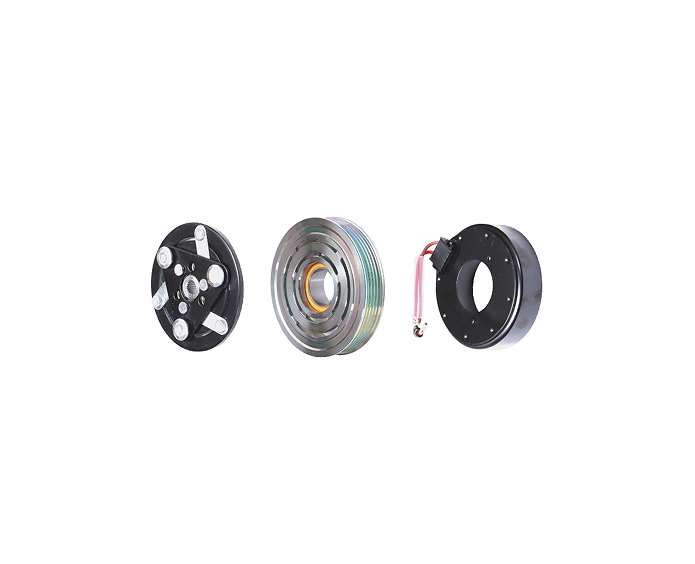
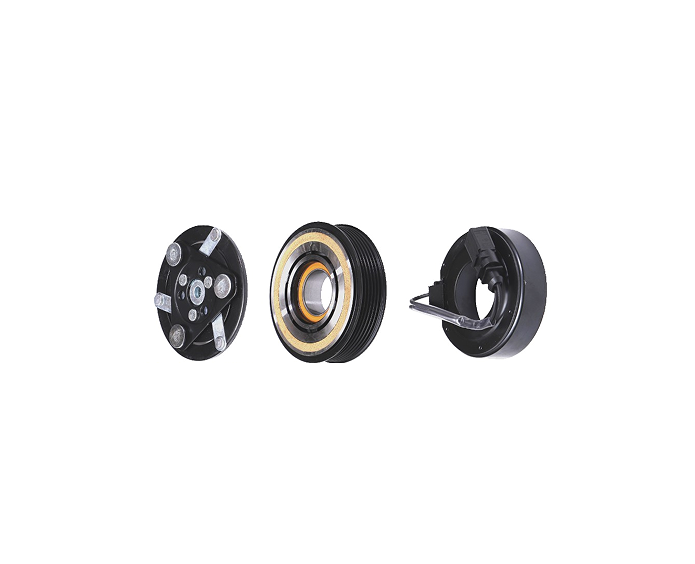
The replacement market often encourages buyers to think in simple descriptions—“6PK clutch,” “125 mm pulley,” or “12 V coil.” Those details are useful, but none defines the complete assembly. An electromagnetic clutch combines several functional components. The pulley receives belt drive, the bearing supports pulley rotation, the coil produces the magnetic force required for engagement, and the hub or armature structure transmits rotation to the compressor when engaged. KASEN explains this relationship in How Does an Auto AC Compressor Clutch Work?.
For sourcing, this means substitutions should be controlled. If the bearing changes, the supplier and buyer need to determine whether its approved specification remains equivalent for the selected assembly. If a coil or connector changes, electrical and fitment requirements may need to be reviewed. If the pulley changes, diameter alone does not establish compatibility.Buyers should ask which component characteristics are fixed in the approved SKU and which alternatives, if any, are permitted.
Material descriptions should be handled with the same discipline. Rather than requesting vague phrases such as “premium steel,” identify which component needs a defined material or surface requirement and why. Where corrosion protection, coating or another treatment is important to the intended market, ask for the applicable specification and evidence rather than extending a general marketing statement to every model.
Evaluate Manufacturing Through Repeatability, Not Factory Appearance
A factory tour can show equipment and production activity, but an aftermarket buyer ultimately needs to know whether the factory can reproduce one approved SKU across multiple purchase orders. KASEN's compressor clutch manufacturing process describes stages including material preparation, machining, coil winding, assembly, inspection and packaging. These stages provide a useful structure for supplier evaluation, but model-specific requirements should still be confirmed separately.
Ask the supplier to take one proposed reference and show how its specification reaches production.Which dimensions are checked after machining? How is the correct bearing linked to the assembly? Which coil characteristics are inspected? How are similar components separated during assembly? What happens when production changes from one reference to another? How is a nonconforming product identified and prevented from entering finished stock?
This approach is more valuable than assuming a modern machine automatically produces a compliant clutch. Equipment establishes potential capability; the controlled process, inspection criteria and records show how that capability applies to the product your company intends to purchase.
Approve a Representative Sample Before Expanding Inventory
For a new replacement reference, sample approval should be tied to a documented specification. Record the KASEN product number, buyer SKU, compressor information, sample revision, measurements, photographs and approval result. If fitment testing is necessary, use an appropriate compressor or vehicle application and have the assessment performed by personnel familiar with the system.
A sample should also be representative of the intended supply configuration. If the first sample is manually selected or built differently from normal production, ask how the bulk product will be controlled against it.When the sample changes, create a new revision rather than referring to several different physical parts as “the approved sample.”
An aftermarket AC compressor clutch supplier serving long-term distributors should support the transition from sample to repeat order. The important sequence is straightforward: identify the application, define the specification, approve the sample, release production, inspect the batch and preserve the approved reference for future orders.
Separate Production Inspection From Product Validation
Not every quality activity proves the same thing. Dimensional and electrical production checks determine whether manufactured units meet agreed requirements. A sample fitment review checks whether the chosen configuration suits the intended application. Endurance, temperature, vibration, corrosion or other validation tests—when required—evaluate particular conditions under a defined test method. One should not automatically be presented as proof of the others.
Before approving a supplier, state which checks are required for incoming components, in-process production and finished assemblies. Ask how acceptance limits are defined and what happens to out-of-specification parts.For any test report that materially affects a purchasing decision, confirm which product reference was evaluated, what conditions were used and what acceptance criteria applied.
The same caution applies to certificates. A company-level management certificate, a material document and a product test report have different scopes. Do not assume a logo displayed on a website proves every clutch or every custom configuration. For supplier qualification, the useful evidence is the document relevant to the product, process or claim being evaluated.
Compare Real Product References Instead of General Compatibility Claims
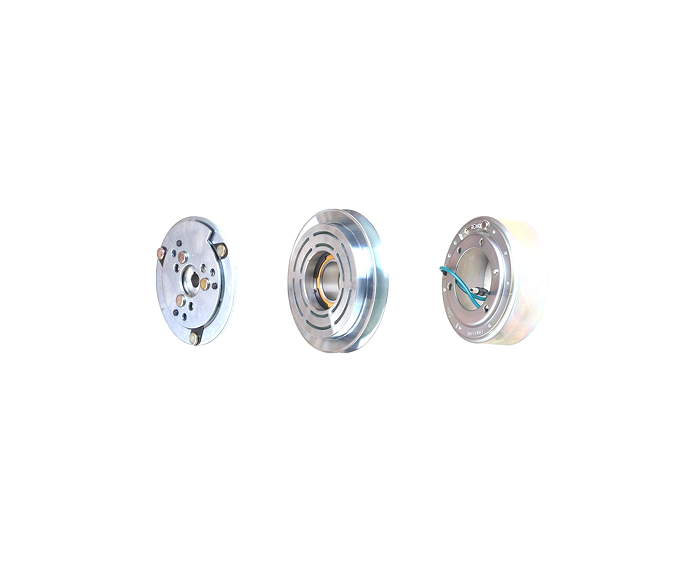
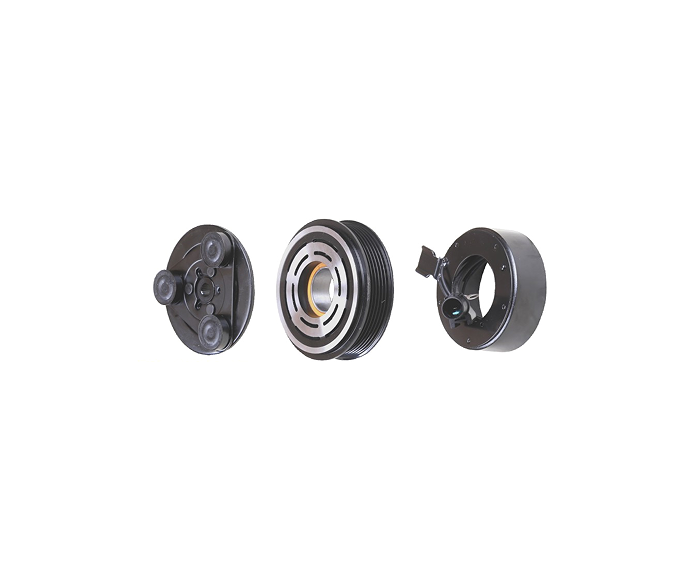
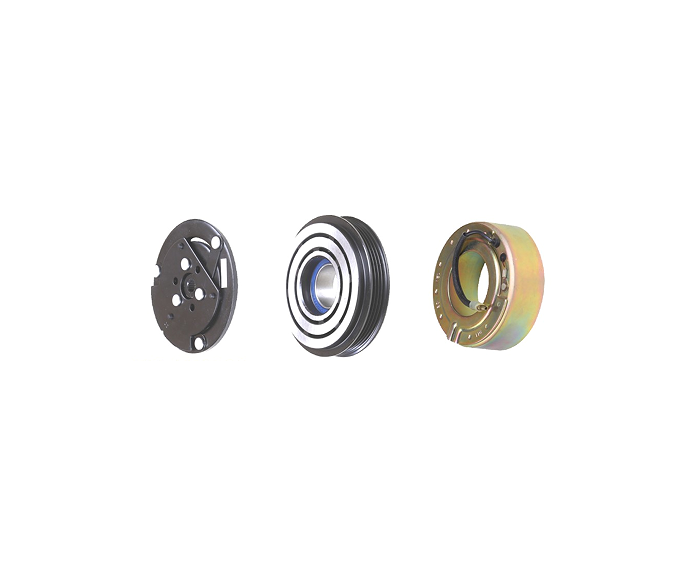
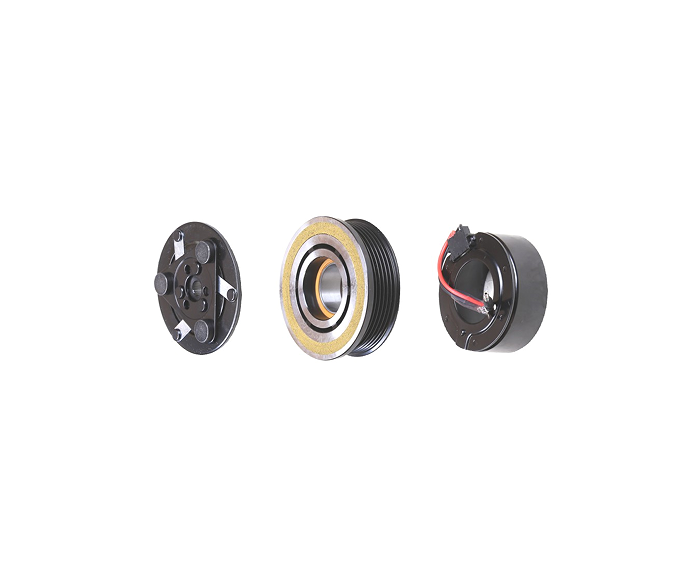
An aftermarket catalogue becomes easier to manage when each SKU is based on actual product-level data. The following KASEN references show how several clutch assemblies can share one characteristic while differing elsewhere. Published vehicle descriptions are useful reference labels but do not, by themselves, confirm every vehicle year, engine, compressor variant or regional configuration.
The published information demonstrates why one shared field is insufficient. KS-801009 and KS-801010 both list a 125 mm pulley and bearing code 355212, but their belt-groove specifications differ. KS-801010, KS-801011 and KS-805051 all list 6PK, yet their published pulley diameters and bearing codes are not the same. KS-801010 also has no rated-voltage value shown on its current product page, so that field should remain unconfirmed rather than being copied from a similar reference.
This is a practical rule for every AC compressor clutch distributor: catalogue similarity is not the same as interchangeability. A model comparison table can help shortlist products, but final approval should remain connected to the compressor and agreed technical information.
Plan MOQ and Lead Time Around the SKU Mix
Aftermarket distributors rarely purchase only one reference. A real order may contain fast-moving models, new trial items and lower-demand applications. Therefore, ask the aftermarket AC compressor clutch supplier to quote minimum order quantities at SKU level as well as conditions for the overall mixed order. Packaging minimums should be separated from product minimums because custom printed packaging may have different commercial requirements.
Lead time should likewise be divided into stages when relevant: identification, sample preparation, sample approval, production, inspection, packaging and dispatch. If several references are combined in one order, determine whether a delayed SKU will postpone the entire shipment or whether split delivery can be arranged.
KASEN's published low-MOQ clutch ordering guidance indicates that order conditions vary by product reference. Therefore, use the current quotation for the actual SKU mix rather than applying one minimum quantity or delivery promise to the entire clutch catalogue.
Control Inventory Cost by Managing Wrong-Fitment Risk
The lowest clutch price does not automatically create the lowest aftermarket cost. A wrong reference can create inbound freight, repacking, warehouse handling, technician complaints, customer returns and slow-moving inventory. A technically correct product can still become a commercial problem if the distributor cannot identify it reliably or its application information is unclear.
When comparing suppliers, calculate the product price together with your own cost of sample approval, inspection, freight, packaging and inventory holding. Then consider how easily a disputed item can be traced to an order and specification. Do not invent a return rate or warranty cost when there is no historical data; instead, use your company's actual records once the program begins.
This also changes how buyers should evaluate product range.Fifty thoroughly confirmed, regularly demanded SKUs may create more useful sales coverage than several hundred poorly documented references. The goal is not catalogue size by itself but sellable, identifiable and repeatable stock.
Require Change Control for Repeat Orders
The first order tests whether a supplier can deliver an acceptable product. Repeat orders test whether the supply system is stable. Before purchasing at scale, agree which changes require notification. Depending on the approved reference, these may include a bearing substitution, coil or connector change, pulley revision, surface treatment change, supplier-component change or packaging revision.
When a proposed change affects the controlled specification, ask for its reason, affected SKU, first affected batch and supporting comparison. Decide whether documentation review, a new sample or additional verification is required. This process is especially important for private-label aftermarket products because the distributor's customer continues to order under the same buyer SKU even when upstream production changes.
KASEN's recent automotive compressor clutch factory guide also emphasizes defining the specification, maintaining production against it and controlling component or process changes. That manufacturing discipline is directly relevant to aftermarket supply because catalogue continuity depends on more than a successful first shipment.
Use OEM and Private Label Only After Fitment Is Stable
An aftermarket brand may want its logo, custom carton, barcode and buyer SKU on the clutch range. These are legitimate commercial requirements, but branding should come after technical identification. Otherwise, a distributor can invest in packaging for a product whose application has not yet been fully approved.
Separate three project types. A standard replacement supply uses an existing confirmed product. A private-label project retains the approved product while adding buyer identification and packaging. A technical OEM project changes product characteristics and therefore needs engineering review, revised samples or other approval work according to the modification.
KASEN states that it welcomes custom production discussions using customer drawings or OEM numbers.Buyers considering more extensive development can also review KASEN's AC compressor clutch OEM information. The available customization, minimum quantity, tooling, testing and schedule should still be confirmed for the specific project rather than assumed from a general OEM capability statement.
Prepare a Better RFQ for an Aftermarket AC Compressor Clutch Supplier
A useful sourcing enquiry allows the supplier to determine what is known and what still needs confirmation. Provide the compressor or OE reference, vehicle information where relevant, clear product photographs, available dimensions, pulley groove, known voltage, expected quantity by SKU, destination market and packaging requirement. If you are replacing an existing supplier, include a sample or controlled drawing when available and identify which characteristics cannot change.
Also explain the commercial purpose of the enquiry. A first sample request, a mixed-model trial order, a private-label program and a recurring distributor order require different discussions. If annual demand is only an estimate, label it as a forecast instead of a committed quantity.
You can begin by reviewing the KASEN AC compressor clutch range, then submit the selected references through the KASEN enquiry page. A complete RFQ gives both sides a better basis for discussing fitment, samples, current MOQ, packaging and delivery conditions.
Frequently Asked Questions
1. How do I choose an aftermarket AC compressor clutch supplier?
Compare the supplier's fitment process, product-level technical information, sample approval, manufacturing control, SKU identification, change management, packaging capability and repeat-order support. Ask for evidence connected to the particular models you intend to purchase instead of relying only on claims such as “large range” or “high quality.”
2. Is a vehicle model enough to identify the correct compressor clutch?
It is useful information, but it should not normally be the only reference for a professional wholesale order.Where possible, combine the vehicle information with the compressor model, OE/reference number, pulley dimensions, belt-groove information, coil voltage, bearing details, connector and product photographs.
3. Can two clutches with the same pulley diameter be interchangeable?
Not necessarily. The KASEN examples above show that KS-801009 and KS-801010 both publish a 125 mm pulley and the same bearing code while listing different groove configurations. Other dimensions, electrical requirements and compressor interfaces may also differ, so one matching value does not prove interchangeability.
4. Should distributors approve a sample before a bulk order?
Sample approval is particularly useful for a new application, uncertain cross-reference, private-label program or commercially significant order. Connect the approved sample to a product specification and buyer SKU so purchasing and quality teams know which configuration future production should match.
5. How should I decide which clutch models to keep in stock?
Use your own enquiry frequency, repair-shop demand, sales history and compressor applications.Keep regularly requested, validated references as core stock; use controlled trial quantities for promising new applications; and consider special-order sourcing for low-demand references. This helps balance availability and inventory risk.
6. Can different clutch models be included in one wholesale order?
Potentially, but mixed-model conditions should be confirmed with the supplier. Ask about MOQ by SKU, combined-order requirements, packaging, item identification and whether all models will be ready at the same time. Do not assume commercial conditions for one clutch automatically apply to another.
7. What is the difference between aftermarket supply and OEM customization?
Aftermarket supply usually focuses on replacement products for service and distribution channels. Private-label supply may add your brand, SKU or packaging without changing the product. A technical OEM customization changes the product specification and requires a separate engineering and approval process.
8. What quality records should an importer request?
The appropriate records depend on the product and purchasing requirement.Start with the approved specification and ask which incoming, dimensional, electrical, assembly or finished-product checks apply. Where additional validation is required, define the model, test method, conditions and acceptance criteria rather than asking simply for “all certificates.”
9. How can I reduce problems when reordering the same clutch?
Purchase against the approved buyer SKU, supplier model, specification or sample revision and packaging record. Require notification for relevant changes and make sure receiving inspection checks the delivered identification against the purchase order. This reduces dependence on photographs or informal product names.
10. What should I send KASEN to request a quotation?
Send the compressor or OE number, vehicle information where known, existing clutch photographs, available measurements, required quantity, destination and packaging requirements. If information is missing, clearly identify the unknown fields. You can submit these details through Contact KASEN for product matching and quotation discussion.
Conclusion
Choosing an aftermarket AC compressor clutch supplier is a catalogue-management and supply-chain decision as much as a product-purchasing decision. Distributors and importers should build each SKU from verified fitment information, approve representative samples, separate production inspection from validation, plan stock according to real demand and require clear control over future changes. A large replacement range becomes commercially useful only when customers can identify the correct clutch and the distributor can reorder the same approved configuration with confidence. KASEN has focused on automotive air-conditioning products since 2007 and supplies compressor clutches and related AC components to aftermarket and OEM customers. Review the KASEN product range or contact KASEN with your compressor references, quantities, target market and packaging requirements to start a model-specific sourcing discussion.