
Sanden AC Compressor Clutch Supplier: Match the Family, the Number and the Air Gap
A Sanden AC compressor clutch supplier should be qualified on reference evidence, not on the word "Sanden" in a catalogue title. The correct clutch is defined by the compressor family and its four-digit Sanden number, the pulley diameter, groove count and offset, the field coil voltage and connector, and the armature and shim stack that set the air gap. This guide shows importers, distributors, rebranders and workshop groups how to turn a Sanden label into one approved clutch reference — and how to test a supplier against that reference before a bulk order.
Sanden searches behave differently from generic "AC clutch supplier" searches because the brand name sits on two very different things. It sits on genuine Sanden compressors and service parts, and it sits on a large aftermarket of "Sanden-type" compressors and replacement clutches that copy the mounting envelope. A buyer who does not separate those two situations will approve the wrong sample, and the mistake usually only appears at installation, when the belt sits one groove off or the coil connector does not reach the harness.
The purchasing question answered here is narrow: how does a B2B buyer convert a Sanden compressor reference into one repeatable clutch SKU, and what must a Sanden AC compressor clutch supplier prove at each step? For the general supplier scorecard, see our AC compressor clutch supplier checklist. For brand-neutral identification, the OE number matching guide covers cross-references. This article stays inside the Sanden family map, because that is where most wrong-fitment claims begin.
Separate Genuine Sanden, Sanden-Compatible and Sanden-Type
Three purchase situations hide behind one keyword, and each needs a different quotation. A Sanden AC compressor clutch supplier should state in writing which one applies before price is discussed.
| Purchase situation | What the buyer is actually buying | Evidence the supplier should provide |
|---|---|---|
| Genuine Sanden service clutch | An original part identified by a Sanden part number and supplied through a documented channel | Original number, packaging identity, channel documentation, and confirmation that the number covers the buyer's compressor |
| Aftermarket clutch compatible with a Sanden compressor | An independent replacement clutch engineered to fit a named Sanden compressor model | Matching basis (Sanden model, four-digit number, measured sample or drawing), pulley and coil specification, air-gap setting |
| Clutch for a "Sanden-type" compressor | A replacement clutch for a copy or universal compressor that imitates a Sanden envelope | Compressor manufacturer, measured interface dimensions, and explicit warning that genuine Sanden numbers do not guarantee fit |
The third row is the one buyers underestimate. Universal SD508-style and SD7H15-style compressors are sold widely for retrofit and specialty applications, and their clutch mounting faces are close to the original without being identical. A Sanden AC compressor clutch supplier that answers "yes, it fits Sanden" without asking which compressor the buyer holds has answered a marketing question, not an engineering one.
Map the Sanden Family Before Choosing the Clutch
Sanden model codes carry real information. The number after "SD" describes the compressor architecture, and the architecture decides the clutch envelope: shaft size, hub offset, pulley clearance, coil cavity and the load the clutch has to carry. Every Sanden AC compressor clutch supplier conversation should start here, because two clutches with the same pulley diameter can belong to different families and still not interchange.
| Sanden family | Architecture as published by Sanden | What it means for clutch selection |
|---|---|---|
| SD5H14 | Five-cylinder SD compressor; standard and HD versions appear in Sanden's SD service data | Smaller displacement than the seven-cylinder family, so a Sanden SD5H14 clutch follows the five-cylinder body, pulley envelope and coil cavity |
| SD508 / SD510 | Earlier five-cylinder family, still common in legacy, retrofit and universal applications | Frequently copied by "Sanden-type" compressors; a Sanden 508 clutch pulley is often a two-groove V-belt design, so belt type must be read from the old part |
| SD7H13 | Seven-cylinder SD7H member; Sanden's SD7 catalogue lists 129 cc/rev displacement for this model | Seven-cylinder hub and shaft interface; not a drop-in for five-cylinder clutches |
| SD7H15 | Seven-cylinder SD7H member, widely used in truck, bus and heavy-duty applications | A Sanden SD7H15 clutch is the most common reference in aftermarket listings, and the most common source of "looks the same" errors |
| SD7H15HD | Heavy-duty variant inside the SD7H range | Higher duty expectation; clutch load capacity and coil specification should be confirmed separately from the standard version |
| SD7B10 | Compact SD model listed in Sanden's SD service data | Different body proportions and mounting than the SD7H15, so pulley clearance must be checked on the compressor, not on a photo |
Note what the table does not do: it does not give you a clutch part number. Family membership narrows the field, and the compressor label plus measurements close it. A Sanden AC compressor clutch supplier who can talk through this table and then ask for a label photograph is showing the right instinct.
Decode the Compressor Label and the Four-Digit Number
Sanden compressor identification is usually a combination of a model code and a four-digit part number, for example numbers in the 4300, 4400, 4600 and 4800 ranges that appear on SD5H14 and SD7H15 units. Those four-digit numbers describe a specific compressor build — pulley, ports, coil, and in some cases clutch configuration — so two compressors from the same family can carry different numbers and different clutches. This is why a Sanden AC compressor clutch supplier should ask for the number rather than the vehicle name alone.
| Field on the label or part | Why it decides the clutch | What to send the supplier |
|---|---|---|
| Model code (SD5H14, SD7H15, SD7B10, SD508 …) | Sets the compressor architecture and clutch envelope | Sharp photograph of the model line |
| Four-digit Sanden number | Identifies the specific build, including pulley and coil configuration | Photograph of the number plus any invoice or service record that repeats it |
| Pulley diameter and groove count | Controls belt fit and alignment | Calibrated measurement across the pulley face and a count of grooves |
| Coil voltage and connector shape | Controls electrical compatibility with the vehicle harness | Photograph of the connector, lead length and any diode marking |
| Back-head and port markings | Confirms the compressor variant, which affects clearance around the clutch | Photograph of the rear head and cast letters |
| Old clutch photographs | Shows armature type, dust cover and shim stack | Front, side and rear views with a scale in frame |
Do not fill a missing field with an assumption. "Sanden SD7H15, number not visible" is a useful starting point; "Sanden SD7H15, 8-groove 119 mm, 12 V, connector photographed" is an order. The gap between those two messages is where rework lives.
The Clutch Elements a Sanden-Compatible Supplier Must Confirm
Sanden's published SD service data breaks the clutch down into discrete parts: armature plate, armature dust cover, shaft nut, clutch shims, rotor, pulley and bearing assembly, snap ring, and field coil. Sanden compressor clutch parts are usually sold in exactly this breakdown, and that exploded view is a better RFQ template than any product photo, because each line item can be quoted, inspected and reordered separately.
| Element | Failure if mismatched | Evidence to request |
|---|---|---|
| Armature plate | Poor grip, slip under load, noise at engagement | Plate diameter, friction face description, flatness check, armature type |
| Armature dust cover | Contamination ingress, premature wear | Confirmation that the cover is included in the quoted scope |
| Shaft nut | Incorrect torque take-up or thread damage | Thread specification and whether a new nut is supplied |
| Clutch shims | Air gap outside the specified range | Shim set supplied and the measured air gap after assembly |
| Rotor and pulley with bearing | Belt misalignment, bearing noise, runout | Diameter, groove profile and count, offset, bearing reference or dimensions |
| Snap ring | Pulley or bearing retention failure | Inclusion in the kit and dimensional check |
| Field coil | No engagement, intermittent engagement, harness mismatch | Rated voltage, resistance check, connector type, lead length, diode presence |
This is also the cleanest way to expose scope confusion. A buyer asking for "a Sanden clutch" may receive a bare armature plate, a pulley and bearing only, a coil only, or a complete pre-assembled clutch. Each is a legitimate product; only one matches the repair. Write the scope into the RFQ line by line and require the quotation to answer in the same order. A Sanden clutch kit should name every component it contains, not simply claim to be complete.
Air Gap and Shim Stack: the Number That Decides Engagement
The Sanden clutch air gap is the clearance between the armature and the pulley friction face when the coil is off. It is set by the shim stack, and it is not a universal figure. Published SD7H15 service data republished by clutch distributors lists different targets by armature type — approximately 0.023 in. for a leaf-spring armature, 0.017 in. for a rubber armature, and 0.019 in. for a rubber-damped armature. Always confirm the value against the service data for the exact compressor you hold rather than against a general article, including this one.
Three practical consequences follow. First, a Sanden AC compressor clutch supplier must state whether the assembly arrives with the air gap preset for the buyer's compressor or whether the workshop sets it. Second, the shim set must be in the box; a clutch that cannot be adjusted on installation becomes a comeback. Third, the armature type must be identified from the old part, not guessed from the pulley, because two clutches with identical pulley geometry can require different gaps and therefore different shim stacks.
For a distributor, the air-gap figure belongs in the fitment file next to the Sanden number. It is the field a workshop will ask about first when a clutch engages late, drags, or rattles at idle.
Pulley Geometry: Diameter Is Only the First Number
Aftermarket listings for Sanden applications show how wide the geometry range is: 119 mm eight-groove pulleys on SD7H15 units, 120 mm eight-groove truck pulleys, six-rib serpentine (6PK) versions, and two-groove V-belt pulleys on SD508-style compressors. All of those are described as "Sanden clutch" in the market, and none of them are interchangeable. A Sanden AC compressor clutch supplier that quotes from diameter alone has skipped the measurement that matters.
Four measurements decide fit: outside diameter, groove count and profile, pulley width, and offset from the mounting face. A fifth decides durability: bearing seat and bearing type. Ask the supplier which of these are controlled dimensions on the drawing, and how runout or balance is verified. A pulley that measures correctly across the face can still misalign the belt if the offset is wrong, and belt misalignment is one of the most common causes of premature bearing failure and edge wear on the belt itself.
Coil, Connector and Suppression
The field coil is where electrical and mechanical fitment meet. Confirm rated voltage — 12 V for most passenger applications, 24 V for many bus, truck and off-highway systems — and never infer voltage from the vehicle category. Then confirm the connector body, terminal count, lead length, and whether the coil carries a suppression diode, because a coil that fits mechanically but not electrically produces a clutch that never engages or a circuit that fails a workshop diagnostic.
Ask for the resistance or current check the supplier performs, and the acceptance window. A stated electrical test with a stated limit is evidence; "tested before shipment" without a value is not. A Sanden AC compressor clutch supplier that can quote a resistance window and a connector part number is easier to hold to a repeat order than one that quotes only a voltage label.
Approve a Sample in Four Stages
Sample approval for a Sanden reference should be a sequence with named outputs, not a visual check followed by a purchase order. Choose a Sanden AC compressor clutch supplier by what its sample process produces, not by how quickly it ships the first unit.
Stage 1: identity and dimension
Compare supplier label, buyer SKU, Sanden model, four-digit number, and the sample itself. Measure pulley diameter, groove count and profile, width, offset, hub bore and shaft interface. Record the instrument used. Any dimension that cannot be measured is an open question, not an approval.
Stage 2: electrical and bench check
Verify coil voltage, connector, resistance or current within the agreed window, armature movement, free pulley rotation, bearing noise and fastener condition. Where the supplier publishes a torque, resistance or noise test, ask which reference and test conditions the record covers.
Stage 3: compressor or vehicle trial
Fit the sample to the exact compressor or vehicle in the fitment file. Record belt tracking, engagement and release, cooling performance, abnormal noise, electrical response and any adjustment needed. A Sanden compressor clutch replacement decision also belongs at this stage: if the trial shows internal compressor damage or contamination rather than a clutch fault, the repair scope changes before any bulk order is placed. Work on the refrigerant circuit itself falls under service standards such as SAE J639, so the trial should follow the workshop's normal refrigerant handling and recovery procedure rather than an open-system test.
Stage 4: freeze the approved master
Save the approved sample photographs, drawing revision, product label, included components, air-gap value and packaging artwork under one buyer SKU. Every later order should reference that master, not the phrase "Sanden clutch". Our fitment matching workflow describes how to convert photographs and measurements into that record.
Quality Control from Sample to Repeat Order
Once a reference is approved, the risk moves from fitment to consistency. What a buyer needs from a Sanden AC compressor clutch supplier is a short receiving plan that checks the fields most likely to drift: product identity, pulley geometry, bearing reference, coil voltage and connector, armature type, shim set, included hardware, and label accuracy.
Change control matters more than sampling volume. Require written notification before any change to a bearing source, coil winding, connector, pulley geometry, friction material, or manufacturing location affecting the approved SKU. A supplier that cannot say which revision a certificate covers is not offering traceability, whatever the certificate says. The clutch inspection guide sets out a fuller receiving framework.
| Control point | What to check | Record kept |
|---|---|---|
| Incoming identity | Buyer SKU, supplier reference, Sanden number on label | Receiving report with photographs |
| Critical dimensions | Pulley diameter, grooves, width, offset, hub bore | Measured values against the approved drawing |
| Electrical | Voltage marking, connector, resistance or current | Test value and instrument |
| Assembly scope | Shims, snap ring, dust cover, shaft nut, hardware | Count per carton against the approved list |
| Traceability | Batch or lot code linking part, carton and inspection record | Batch register by shipment |
Prepare a Sanden RFQ That Gets a Technical Answer
A short message with the right ten fields will outperform a long one without them — and it is the fastest way to compare one Sanden AC compressor clutch supplier with another. Use this structure per proposed SKU and attach the photographs in the same message.
- State whether you need a genuine Sanden part, an aftermarket clutch compatible with a named Sanden compressor, or a clutch for a Sanden-type compressor.
- Give the Sanden model code and the four-digit number, plus vehicle make, model, year, engine and market.
- Attach the compressor label, old clutch front, side and rear views with a scale, and the connector close-up.
- Provide pulley diameter, groove count and profile, width, offset, hub bore, and bearing reference if legible.
- Confirm coil voltage, connector type, lead length and diode requirement.
- State the required supply scope: complete pre-assembled clutch, pulley and bearing, coil, armature plate, shim set, or full kit.
- Ask for the air-gap target and whether it is preset, plus the shim range supplied.
- Give sample quantity, opening order, annual forecast, number of SKUs, destination and delivery window.
- List the drawing, inspection, electrical and traceability evidence required for approval.
- Specify neutral or private-label packaging, barcode, carton quantity, label language and pallet rules.
Ask the supplier to reply in the same numbered order and to mark any field it cannot confirm. That single instruction filters out most of the vague quotations a buyer receives.
Our Clutch Range for Sanden-Compatible Programs
Guangzhou Kasen has manufactured and exported automotive air conditioning components since 2007, supplying compressors, clutches, electric compressors, valves and bearings to aftermarket and OEM-related buyers, with stated OEM customization using buyer drawings or OEM numbers. Our clutch range is catalogued by reference rather than by brand claim, so the matching work happens before the quotation.
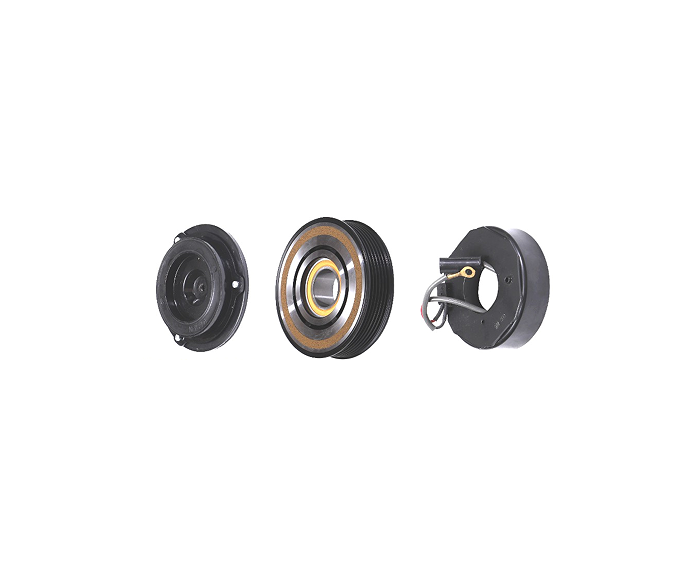
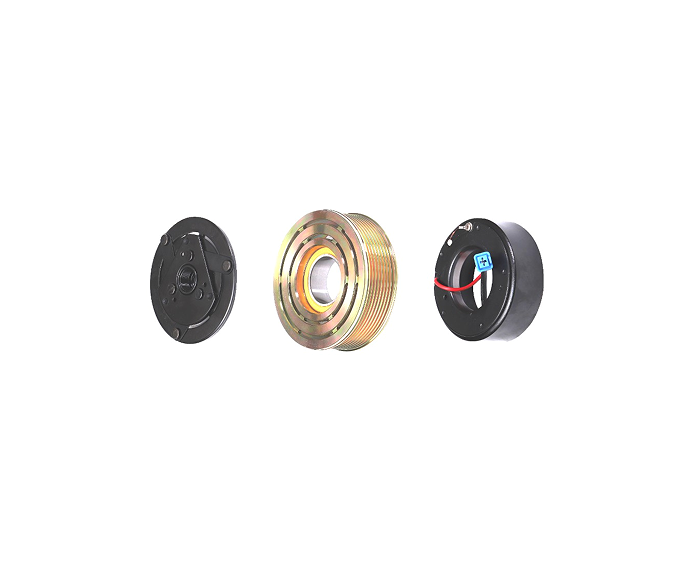
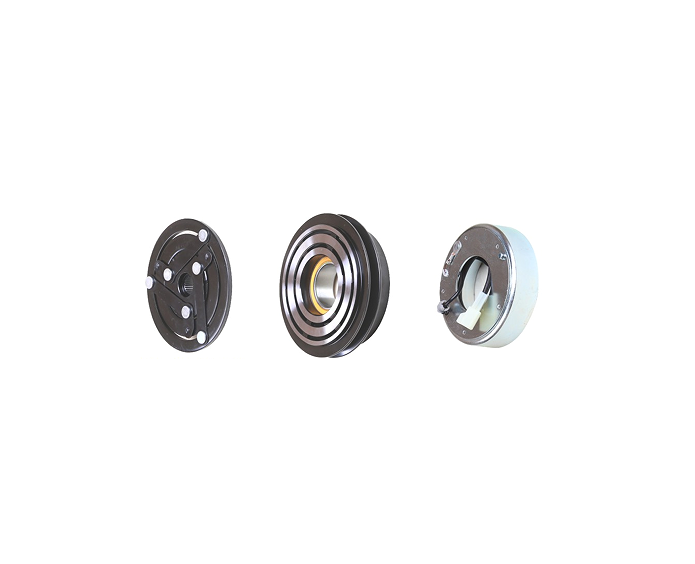
The AC clutch assembly for compressor and HVAC applications (reference KS-821381) is documented as an electromagnetic clutch and pulley assembly with a multi-groove belt pulley, a central hub bore, mounting features on the front face, and on one version an electrical lead and connector. Its published description notes black coated or plated metal finishes and asks buyers to confirm whether they need a complete clutch, a pulley-only service part or a kit — which is exactly the scope question a Sanden enquiry should answer first.
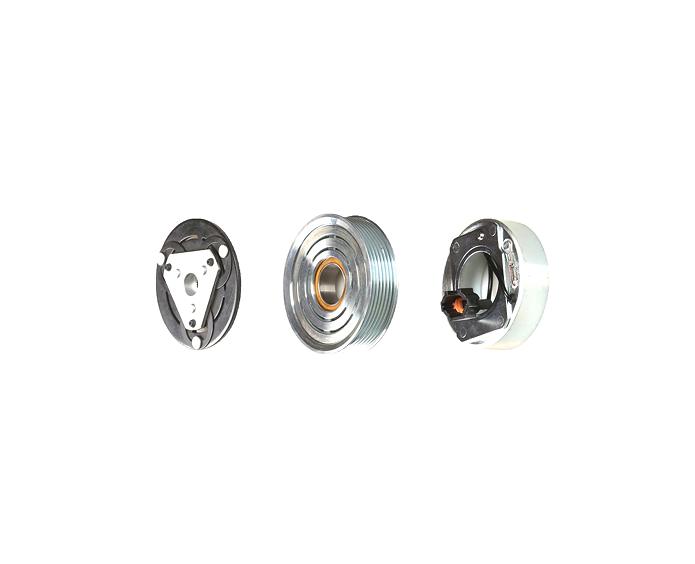
The AC compressor clutch for replacement and OEM matching (reference KS-821473) is described as a circular electromagnetic clutch-style assembly with a central bore, layered ring structure, fastener points and a protected electrical connector. The page states plainly that internal design cannot be confirmed from images and that shaft bore, mounting pattern, connector style and coil configuration must be verified — the discipline this article is asking for.
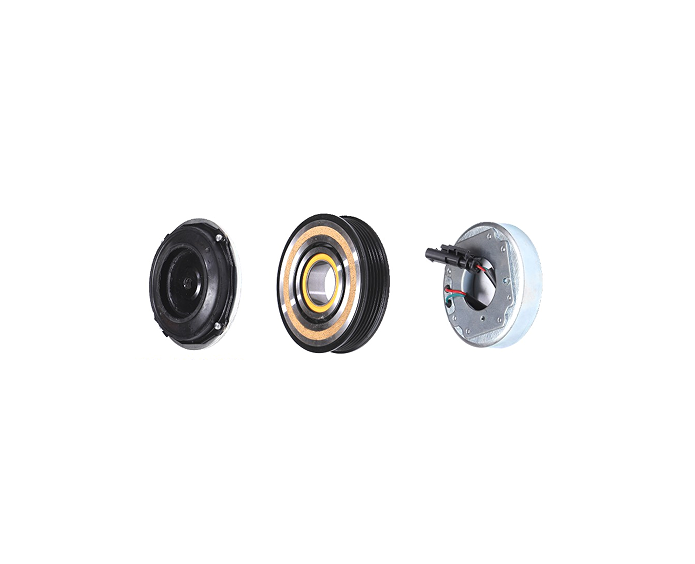
For component-level supply, the AC clutch components for automotive compressor service group (reference KS-821489) documents a clutch hub or armature assembly, a multi-groove pulley with a slotted front face, and a black coil housing with a wiring lead and connector. These are the same three elements that decide engagement on a Sanden compressor, offered as separately identifiable parts rather than an all-or-nothing assembly.
None of those references is presented as a genuine Sanden part, and none of them should be ordered for a Sanden application until the model, four-digit number, pulley geometry, coil specification and air gap have been confirmed against the buyer's compressor. Send the label and measurements through the contact page or the enquiry form and the matching discussion can start from data rather than from a product photo.
Common Mistakes in Sanden Clutch Purchasing
- Buying by vehicle model only. A vehicle can carry more than one compressor family across years, engines and markets.
- Treating SD5H14 and SD7H15 clutches as interchangeable. Five-cylinder and seven-cylinder bodies use different interfaces even when the pulley looks similar.
- Matching on pulley diameter. Diameter without groove profile, width and offset is not a fitment.
- Ignoring the armature type. It sets the air-gap target and therefore the shim stack.
- Assuming "Sanden" means genuine. The market is full of Sanden-type compressors and compatible clutches; the status must be stated.
- Leaving scope undefined. Shims, snap ring, dust cover and shaft nut are frequently missing from "complete" kits.
- Inferring voltage from the vehicle class. 24 V systems exist well beyond heavy trucks; read the coil.
- Approving a sample without a drawing revision. Without a revision, the next batch has nothing to conform to.
- Choosing a Sanden AC compressor clutch supplier on price alone. The cheapest quotation usually leaves the measuring, shimming and change control with the buyer.
FAQ for Sanden AC Compressor Clutch Buyers
Is a Sanden AC compressor clutch supplier the same as a Sanden distributor?
No. A distributor sells original parts through a documented channel; a manufacturer or exporter supplies compatible aftermarket clutches matched to Sanden references. Both can be legitimate, but the buyer must know which relationship is being quoted, because the evidence and the traceability path differ.
Can I identify a Sanden clutch from the four-digit number alone?
It narrows the field considerably but is not sufficient on its own. The number identifies a compressor build; the clutch still needs confirmation of pulley geometry, coil voltage and connector, armature type and air-gap setting. Use the number plus the model code plus measurements.
Do SD5H14 and SD7H15 clutches interchange?
Do not assume so. They belong to different compressor architectures with different hub and shaft interfaces, even where aftermarket listings show similar pulley diameters. Confirm the interface on the actual compressor before approving a sample.
What air gap should a Sanden clutch be set to?
It depends on the armature type and the compressor. Published SD7H15 service data republished by clutch distributors cites roughly 0.023 in. for a leaf-spring armature, 0.017 in. for a rubber armature and 0.019 in. for a rubber-damped armature. Confirm against the service data for your exact unit.
Why do two clutches with the same pulley diameter not fit the same compressor?
Because diameter describes only the belt surface. Groove profile and count, pulley width, offset, hub bore, shaft interface, coil cavity and air-gap stack all vary between references — and those are the fields that decide whether the belt tracks and the clutch engages.
Should I order a complete clutch or individual components?
It depends on the diagnosis. If the coil has failed but the pulley bearing and friction faces are sound, a coil may be enough; if the bearing is noisy or the friction face is worn, a full assembly is usually the safer scope. Define the scope in the RFQ either way.
How do I control quality on repeat Sanden clutch orders?
Keep the approved master — photographs, drawing revision, air gap, component list, packaging — and check identity, critical dimensions, electrical values and scope at receiving. Require written notification before any component or process change affecting the approved SKU.
Can Kasen supply a clutch for a Sanden-type compressor rather than a genuine Sanden unit?
Yes, subject to matching. Because Sanden-type compressors copy the envelope without necessarily copying every interface dimension, the buyer should supply measured dimensions and photographs rather than a family name. Our team will confirm what can be matched and what remains unverified before quoting.
Conclusion
A Sanden AC compressor clutch supplier is only as reliable as the reference it works from. Family first — SD5H14, SD508, SD7H13, SD7H15, SD7H15HD or SD7B10 — then the four-digit number, then pulley geometry, coil and connector, then the armature type and air gap that decide engagement. Suppliers who ask for those fields before quoting are doing the engineering; suppliers who quote from a photo are guessing.
Build the fitment file once, approve one sample per reference, and control the scope in writing. That record is what makes the second and third orders boring, which is the outcome a distributor actually wants. To check a specific Sanden reference, send the compressor label, the four-digit number, clutch photographs and measurements through our contact page, and the matching discussion can begin with your data instead of a catalogue description.