
Magnetic Efficiency Optimization in Automotive Air Conditioner Clutch Design
Why Magnetic Efficiency Determines Clutch Performance
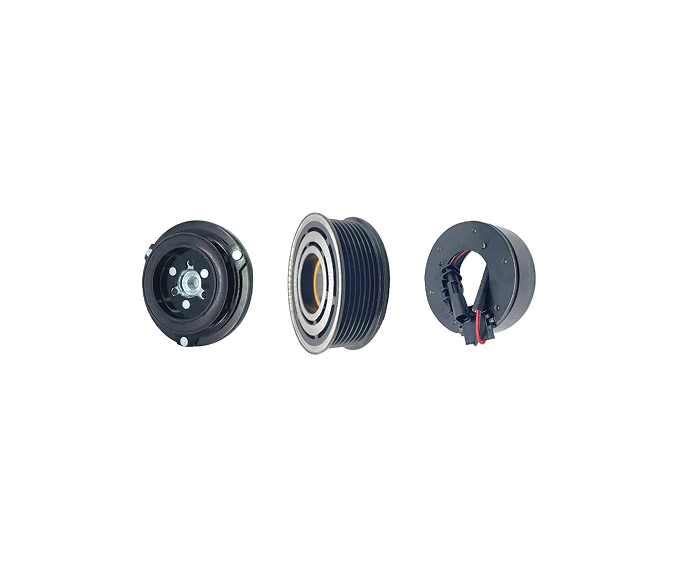
The electromagnetic actuation mechanism is the operational core of any automotive air conditioner clutch.
When voltage is applied, the coil generates magnetic flux, pulling the armature plate toward the rotor. Engagement quality depends on how effectively that magnetic energy converts into mechanical force.
Poor magnetic efficiency results in:
- Delayed engagement
- Increased coil temperature
- Higher power draw
- Reduced service life
Optimization is not optional. It defines reliability.
Magnetic Circuit Geometry and Flux Concentration
Magnetic efficiency begins with circuit design.
Key engineering considerations include:
- Core material permeability
- Flux path continuity
- Air gap precision
- Saturation threshold control
Minimizing magnetic leakage is critical. Any flux escaping the intended path reduces engagement force.
In a high-performance automotive air conditioner clutch, finite element magnetic simulation is typically used to:
- Map flux density distribution
- Identify leakage zones
- Optimize pole shape
- Refine armature surface alignment
Small geometric refinements significantly increase magnetic pull force without increasing power input.
Efficiency gains come from precision.
Coil Design: Resistance, Turns, and Thermal Balance
The electromagnetic coil is both energy source and thermal risk.
Increasing coil turns strengthens magnetic field intensity, but also raises resistance and heat generation.
Engineering balance must consider:
| Parameter | Impact on Efficiency |
|---|---|
| Coil Turns | ↑ Magnetic Strength / ↑ Resistance |
| Wire Gauge | ↓ Resistance / ↑ Space Occupancy |
| Voltage Stability | Direct Flux Consistency |
| Insulation Grade | Thermal Endurance |
An optimized automotive air conditioner clutch coil reduces power draw while maintaining engagement force thresholds.
Lower resistance reduces thermal fatigue.
Thermal control extends lifespan.
Air Gap Optimization and Engagement Response Time
The air gap between rotor and armature is one of the most sensitive variables in clutch performance.
A wider air gap:
- Requires higher magnetic force
- Increases engagement delay
- Raises coil temperature
A narrower air gap:
- Improves response time
- Reduces required flux density
- Enhances magnetic efficiency
Precision machining tolerance becomes critical.
In advanced automotive air conditioner clutch systems, micron-level control of air gap uniformity directly correlates with engagement speed and long-term reliability.
Mechanical precision reinforces magnetic performance.
Magnetic Material Selection and Saturation Limits
Core materials determine flux density capability.
Low-grade steel may saturate prematurely under high current, limiting effective magnetic force.
High-permeability alloys enable:
- Stronger flux concentration
- Lower energy requirement
- Reduced current load
- Faster actuation
Material selection significantly influences automotive air conditioner clutch efficiency curves.
Better magnetic materials allow reduced electrical stress.
Reduced electrical stress improves system stability.
Power Consumption and Energy Optimization
Modern vehicles increasingly emphasize energy efficiency.
Lower magnetic losses mean:
- Reduced alternator load
- Lower fuel consumption impact
- Improved compatibility with hybrid platforms
- Reduced thermal expansion stress
In energy-optimized automotive air conditioner clutch systems, power draw reductions of 8–15% can be achieved through magnetic path refinement and coil recalibration.
Efficiency directly affects vehicle system integration.
NVH Implications of Magnetic Performance
Magnetic engagement affects noise, vibration, and harshness.
Inconsistent magnetic pull can cause:
- Partial engagement chatter
- Micro-slip vibration
- Acoustic clicking during activation
Optimized flux uniformity ensures:
- Smooth armature contact
- Balanced engagement pressure
- Reduced oscillation
In high-end vehicle applications, automotive air conditioner clutch magnetic tuning contributes to cabin comfort standards.
Magnetic stability equals acoustic stability.
Heat Dissipation and Long-Term Durability
Magnetic inefficiency often manifests as excessive heat.
Elevated coil temperature accelerates:
- Insulation degradation
- Resistance increase
- Flux reduction
- Early failure
Thermal mapping during design validation is essential.
By improving magnetic conversion efficiency, less input energy becomes waste heat.
An optimized automotive air conditioner clutch experiences slower thermal aging and extended operational cycles.
Durability is engineered, not assumed.
Engineering Direction for Future Platforms
Emerging vehicle platforms demand:
- Lower energy draw
- Faster response time
- Higher durability in extreme climates
- Integration with intelligent HVAC controls
Magnetic optimization will remain central.
Advancements in simulation software, material science, and manufacturing precision continue to push performance boundaries.
For detailed technical collaboration and optimized magnetic circuit solutions in automotive air conditioner clutch systems, explore our engineering capabilities at
👉 https://www.gzkasen.com/
For technical discussions and development partnerships, connect directly at
👉 https://www.gzkasen.com/contact-us
Magnetic efficiency is not just a parameter. It defines performance architecture.