
What Should a China AC Compressor Clutch Manufacturer Provide?
A China AC compressor clutch manufacturer should provide more than a catalogue, a quotation and a claim that a clutch “fits Toyota,” “fits Honda” or “fits Nissan.” For professional importers, the real value is the ability to connect a specific compressor application with a controlled clutch configuration, manufacture that configuration repeatedly and keep product identification stable across future orders.
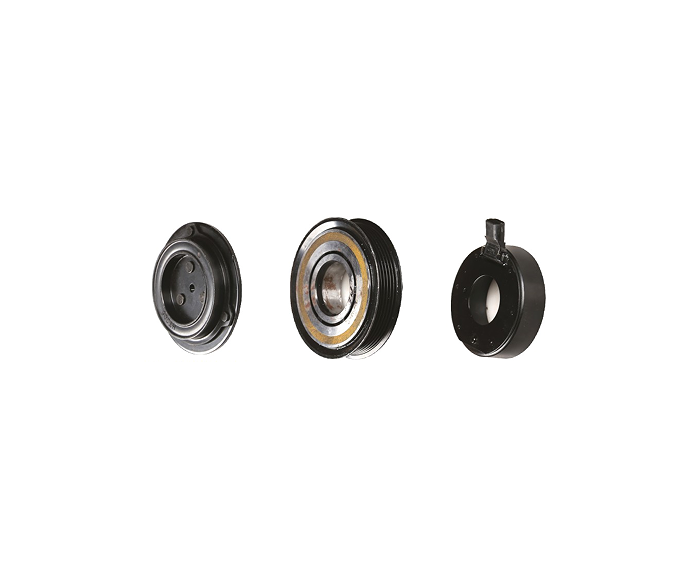
That matters because compressor clutches that look almost identical can differ in pulley diameter, belt-groove specification, bearing, coil voltage, connector, hub geometry and mounting details. A purchasing team therefore needs product-level information before it needs a low bulk price. Guangzhou Kasen Auto Air Conditioner Co., Ltd. is based in Guangzhou, China and states that it has focused on automotive air-conditioning parts since 2007, supplying compressor clutches, compressors, electric compressors, valves and bearings to aftermarket and OEM customers. KASEN company profile
For B2B buyers, the supplier-selection question should be: Can this manufacturer identify, approve, produce and reproduce the clutch reference we intend to sell? That question is more useful than asking only whether the company has a large factory or a large number of product codes.
Which Buyers Should Source Directly From a China Manufacturer?
Working with a China AC compressor clutch manufacturer is most relevant to automotive AC importers, regional parts distributors, compressor rebuilders, wholesale repair-part suppliers and aftermarket brands managing multiple replacement references. These buyers normally purchase repeatedly, maintain their own SKUs and need the same technical configuration to remain stable from one shipment to the next.
A distributor, for example, may need ten or twenty clutch references in one shipment and must prevent visually similar products from being mixed. A private-label brand needs the technical product, buyer SKU and packaging revision to stay synchronized. A compressor rebuilder may focus on fewer models but require accurate bearing, pulley and coil information because the component must integrate with a known compressor.
Direct manufacturer sourcing is less useful when the buyer has only one unidentified old part and no reliable compressor reference. In that case, product identification should come first. A one-time workshop repair also does not automatically require a factory-level OEM programme. Buyers can begin with the KASEN AC compressor clutch range and narrow the application before discussing bulk production.
Start With the Compressor Application, Not the Vehicle Name
One of the most common sourcing errors is treating the vehicle model as the complete fitment specification. Vehicle information is useful, but a professional RFQ should also identify the compressor and clutch configuration wherever possible.
When sourcing from a China AC compressor clutch manufacturer, provide the OE or existing reference, compressor model or label, vehicle information where known, photographs of the old component and measurable clutch details. If the compressor label is available, include a clear photograph rather than relying on a typed vehicle description.
The buyer should also distinguish confirmed information from assumptions. If the old part measures approximately 125 mm but the exact pulley specification has not been verified, record the diameter as a measurement requiring confirmation. If the coil voltage is unknown, do not infer it from another product that appears similar.
KASEN's existing supplier and wholesale guides use the same underlying principle: similar-looking clutch assemblies can have different technical fields and should not be approved from one shared characteristic alone. Read KASEN's wholesale sourcing guide
Build a Technical RFQ Before Comparing Prices
A useful RFQ gives every manufacturer the same product definition. Without one, two suppliers may quote products that appear commercially comparable but contain different components or supply scopes.
The following table is a buyer-side specification framework. It is not a statement that every KASEN clutch uses the same structure or that every field is available for every product.
| RFQ Item | What the Buyer Should Confirm | Why It Matters |
|---|---|---|
| Buyer SKU | Your internal reference | Connects purchasing, warehouse and sales records |
| Manufacturer reference | Confirmed supplier product code | Supports repeat ordering |
| Compressor identity | Manufacturer/model/reference where available | Establishes the application basis |
| Vehicle information | Make, model, year, engine and market where applicable | Supports catalogue accuracy |
| Supply scope | Complete clutch set or selected components | Prevents quotation differences |
| Pulley | Diameter, groove specification and relevant offset | Controls belt-side fitment |
| Coil | Rated voltage, connector and agreed electrical data | Controls engagement compatibility |
| Bearing | Published/approved reference and required construction | Supports assembly consistency |
| Hub/interface | Shaft connection and locating features | Controls compressor-side fitment |
| Finish | Required surface treatment where relevant | Defines the agreed product appearance |
| Sample status | Proposed, approved or rejected | Controls production release |
| Packaging | Buyer code, label, carton and quantity | Reduces warehouse errors |
| Revision | Current product/specification version | Protects repeat orders |
A price should be compared only after the basic scope is aligned. Otherwise, one quotation may include a complete clutch set while another covers a different component combination.
Evaluate the Pulley, Coil, Bearing and Hub as One System
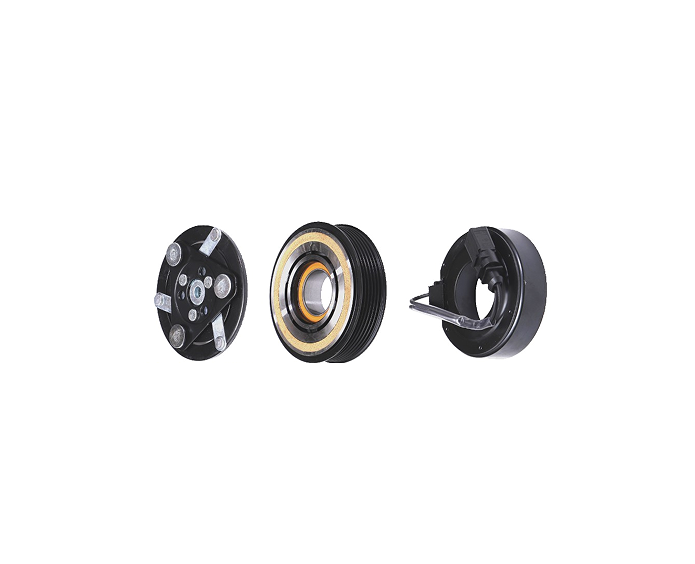
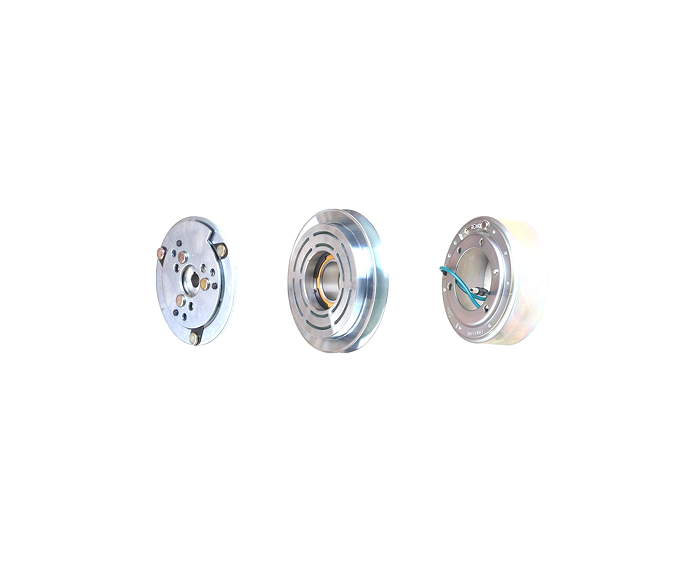
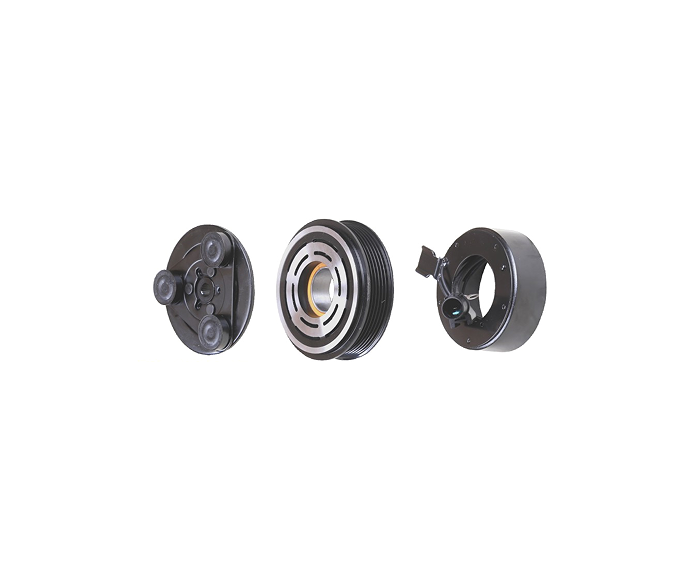
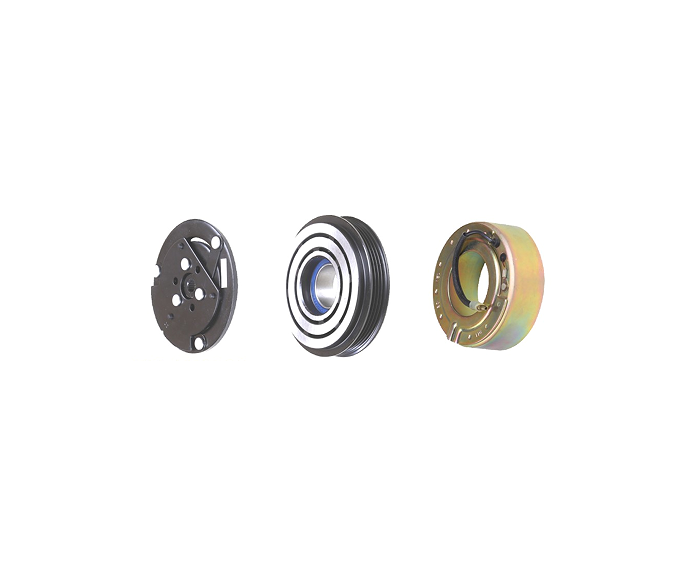
A clutch assembly is not simply a collection of independent parts. The pulley, bearing, electromagnetic coil and hub or armature arrangement must work together with the intended compressor.
For the pulley, confirm the relevant geometry rather than using only the outside diameter. For the coil, confirm the rated voltage and connector and request the applicable electrical requirements for the selected model. For the bearing, retain the complete approved identification rather than replacing it with a generic “same size” description. For the hub or drive plate, check the compressor-side interface and locating structure.
Material information should be handled with the same discipline. Ask which material or surface requirement applies to the selected component instead of accepting broad statements such as “premium steel” or “high-temperature material.” If a coating or finish matters for your market, put that requirement into the product specification.
This is particularly important when evaluating an AC compressor clutch manufacturer in China for a long-term product range. The product your buyer approves should remain tied to a defined component configuration rather than changing invisibly under the same SKU.
Verify Manufacturing Involvement Instead of Relying on the Word “Factory”
A factory evaluation should follow an actual reference through the production process. Ask which operations are performed internally, which components are purchased and how purchased parts are approved. Outsourcing itself does not prove poor quality; what matters is whether the manufacturer controls the specification and can identify when a component or process changes.
KASEN's published manufacturing content describes material preparation, machining, coil winding, assembly and inspection as stages in compressor-clutch production. Buyers can use those stages as questions during a supplier review rather than assuming every process description applies identically to every model. KASEN compressor clutch manufacturing process
For one proposed reference, ask to see how the approved drawing or specification reaches production. How is the correct pulley identified? How is the bearing connected to the right model? Which coil characteristics are checked? What happens during a model changeover? How are rejected components separated? Which records are kept for the finished batch?
This type of review provides more useful evidence than photographing machinery without connecting it to the product being purchased.
Separate Sample Approval, Production QC and Validation
These three activities answer different questions.
Sample approval asks whether the proposed configuration matches the buyer's requirement. Production QC asks whether a shipment conforms to the approved product definition. Validation evaluates a defined performance or environmental condition under an agreed test method.
They should not be treated as interchangeable. A dimensional inspection on a production batch does not establish endurance life. Likewise, an earlier endurance report does not prove that a later shipment contains the correct connector, bearing or label.
When qualifying a China AC compressor clutch manufacturer, define the checks relevant to your programme. These may include product identification, dimensional checks, electrical measurements, visual condition, assembly requirements and functional evaluation. Where endurance, corrosion, vibration, temperature or another validation test is required, request the exact product reference, test method, conditions and acceptance criteria rather than asking only for “a test report.”
The same principle applies to certification. A company-level certificate, a process certificate and a product-specific test report prove different things. Review the organization named on the document, the scope and the validity before extending it to your catalogue claims.
Compare Real Product References Before Approving a Range
Published KASEN product information provides a useful example of why importers should compare several technical fields simultaneously.
KS-801009 and KS-801010 both publish a 125 mm pulley and bearing code 355212, yet the groove specifications differ. KS-801010 and KS-801011 both publish 6PK, while the pulley diameters and bearing codes differ. KS-801010 also currently has no voltage value published, so that field should remain unconfirmed rather than being copied from another reference.
This comparison demonstrates a useful sourcing rule: shared dimensions or shared vehicle-brand language do not establish interchangeability. A model table helps shortlist products; it does not replace final compressor-level fitment confirmation.
Check Capacity and Lead Time Against Your Actual SKU Mix
A manufacturer may publish broad production capability, but buyers need to know whether their particular order can be produced on the required schedule.
Ask for capacity and timing against the selected models, quantities and packaging—not only a headline factory number. Separate sample preparation, technical approval, production, inspection, packaging and dispatch. Clarify what starts the production lead time: deposit, technical release, approved sample or approved artwork.
Mixed-SKU orders require extra attention. A shipment containing fifteen models may be delayed by one reference that requires a different component or approval. Ask whether all SKUs will ship together and whether partial shipment can be considered if one line is delayed.
The same applies to MOQ. A minimum quantity is a commercial condition, not a recommendation for how much stock your warehouse should hold. KASEN has published SKU-dependent low-MOQ guidance for compressor clutch orders, so current conditions should be confirmed for the exact products rather than extended to every reference. KASEN low-MOQ guidance
Evaluate the Manufacturer's Export Fit for Your Market
Cross-border sourcing introduces questions that may not appear in a domestic purchase. Buyers should confirm product identification, packaging language, buyer SKU requirements, shipment documents, packing lists and the commercial terms stated in the quotation. If destination-market documentation is required, include it in the enquiry rather than discussing it after production.
KASEN states that its products are exported to customers in Europe, North and South America, the Middle East and Southeast Asia. That shows that the company positions itself for international trade, but an importer should still confirm the exact documentation, packaging, shipping and product requirements for its own order and destination. View KASEN's global business information
Professional sourcing works best when both sides distinguish forecast quantities, confirmed purchase orders and market-specific requirements. A forecast helps production planning; it should not be treated as a guaranteed purchase quantity unless the buyer has formally committed to it.
Compare Total Sourcing Cost, Not Only the China Factory Price
Buying directly from China does not automatically create the lowest total cost. Unit price is only one part of the commercial decision.
A useful comparison should also consider sample approval, packaging, inspections, freight, stockholding, slow-moving inventory, incoming checks and the administrative cost of resolving an incorrect reference. If one supplier is cheaper but product identification is weak, returns and inventory confusion can offset the initial saving.
For a distributor, the most expensive mistake may be a technically sellable product that has been stocked under the wrong application. The product may pass a factory inspection and still create commercial losses if the catalogue data is inaccurate.
That is why the strongest China AC compressor clutch manufacturer relationship is built around correct fitment, controlled revisions and repeatable replenishment, not the lowest quoted price in isolation.
Define OEM and Private-Label Requirements Separately
KASEN states that it welcomes custom-production discussions based on customer drawings or OEM numbers. Buyers should use that capability carefully by separating three project types. Read the KASEN OEM guide
A standard replacement order uses an existing confirmed product. A private-label programme keeps the approved product while adding buyer branding, labels, barcodes or packaging. A technical OEM project modifies product characteristics and may require engineering review, samples, validation or tooling depending on the change.
Do not let these scopes become mixed in one vague requirement such as “OEM clutch with our brand.” State whether you need a standard product with private packaging or an actual technical modification. This makes quotations easier to compare and prevents packaging approval from being mistaken for engineering approval.
For branded programmes, connect the buyer SKU, supplier reference, product revision and packaging revision in one master record. A later box-artwork change should not silently authorize a technical component change.
Prepare a China AC Compressor Clutch Manufacturer RFQ That Can Be Answered
A strong RFQ reduces the number of assumptions the supplier must make. Send one line per required reference and include the compressor or OE number, vehicle information where known, old-part photographs, relevant dimensions, voltage or connector information, quantity, destination market and packaging requirements.
For a first order, also identify which models require samples and which are already approved references. If the project involves branding or engineering changes, separate those requirements from the standard product request. If information is missing, write “to be confirmed” rather than inserting data from another model.
KASEN invites importers, buyers and partners to discuss custom production and factory cooperation. You can begin with the KASEN product center and submit the selected references through the KASEN enquiry page. Before releasing a bulk order, request one consolidated confirmation covering product references, quantities, outstanding technical points, packaging, current commercial conditions and delivery assumptions.
Frequently Asked Questions About China AC Compressor Clutch Manufacturers
1. Why source from a China AC compressor clutch manufacturer instead of a general parts trader?
Direct manufacturer sourcing can be useful when the buyer needs technical discussion, controlled production, customization or repeat-order consistency. However, do not make the decision from the supplier's job title alone. Verify which operations and components it actually controls and how your selected product is managed.
2. How can I verify that a supplier is really involved in manufacturing?
Follow one proposed reference through its process. Ask how the product specification reaches machining, coil production or sourcing, assembly, inspection and packaging. Request product-specific records where appropriate. Factory photographs alone do not show how one SKU is controlled.
3. What information should I send before asking for a quotation?
Provide the compressor or OE reference, vehicle information where known, old-part photographs, pulley data, voltage, connector information, quantity, market and packaging requirement. Clearly identify unknown information so the manufacturer can determine what requires confirmation.
4. Can I identify a compressor clutch by pulley diameter alone?
No. Published KASEN examples show that two references may share the same pulley diameter while differing in groove configuration, and 6PK references may use different diameters and bearing codes. Final approval should use the full relevant specification.
5. Should I always request a sample before importing in bulk?
A sample is particularly useful for new references, uncertain fitment, private-label projects and technical changes. Established repeat orders may be handled against an existing approved specification, provided no relevant product change has occurred.
6. How should I check quality before shipment?
First define what characteristics matter for the selected clutch. Agree on the applicable dimensional, electrical, visual or functional inspections and the acceptance criteria. Keep routine production checks separate from specialized validation tests.
7. What should I ask about certifications?
Ask for the actual certificate or report relevant to the claim. Check the organization name, scope, model or process coverage and validity. Do not assume that a company-level certificate automatically applies to every individual clutch configuration.
8. Can a China manufacturer support OEM or private-label orders?
KASEN states that it welcomes custom-production discussions using customer drawings or OEM numbers. The actual customization, MOQ, samples, tooling, packaging and technical requirements should be confirmed for the specific project rather than assumed from a general OEM statement.
9. How should I compare quotations from different manufacturers?
Give each supplier the same reference list and specification. Compare the included product configuration, quantities, packaging, inspection requirements, commercial terms and delivery basis. A lower number is not directly comparable if the scope is different.
10. How can I reduce risk on repeat orders?
Connect each purchase order to an approved manufacturer reference, buyer SKU, technical revision and packaging revision. Require review of relevant component or process changes before they enter repeat production. This gives purchasing and quality teams a stable reference for subsequent shipments.
Conclusion
Selecting a China AC compressor clutch manufacturer should be a technical and supply-chain decision rather than a search for the lowest unit price. Importers and distributors should confirm compressor-level fitment, create a controlled specification, evaluate component and process control, separate sample approval from batch QC, compare real product references and define how changes will be managed after the first order. KASEN is based in Guangzhou, China, has focused on automotive air-conditioning products since 2007 and supplies compressor clutches and related AC components for aftermarket and OEM business. Buyers can review the KASEN AC compressor clutch range and send compressor references, quantities, destination market and project requirements through Contact KASEN to begin a model-specific sourcing discussion.