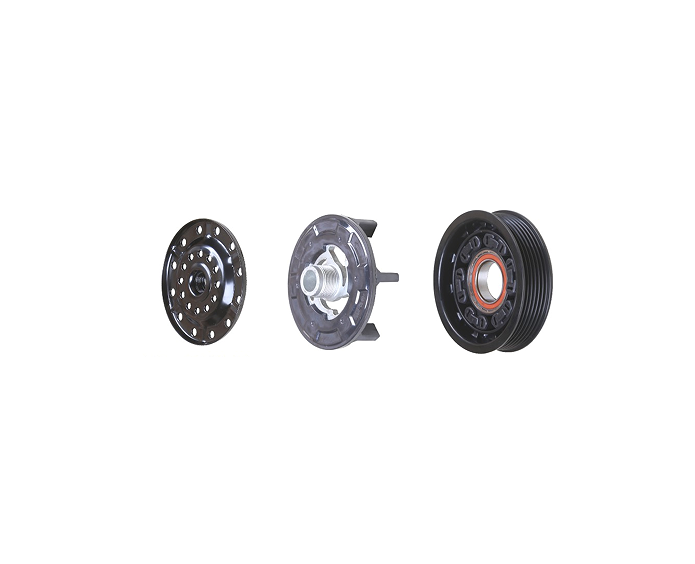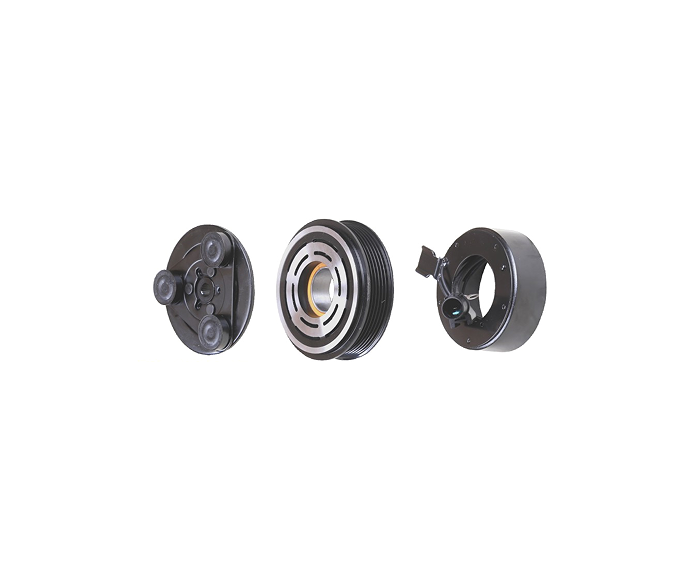

Why Automotive AC Compressor Clutch Selection Matters
An automotive AC compressor clutch is the mechanical and electromagnetic connection between the engine-driven pulley and the air conditioning compressor in many conventional vehicle AC systems.
For an individual repair, a technician may only need to find a clutch that fits one compressor.
For distributors, importers, wholesalers, repair networks, and aftermarket brands, the purchasing challenge is much broader.
A professional buyer has to verify:
- Compressor model
- OE reference
- Pulley diameter
- Groove number
- Coil voltage
- Bearing dimensions
- Hub design
- Connector configuration
- Air gap
- Vehicle application
- Repeat-order consistency
A clutch can look almost identical to another model and still be incompatible because of a small dimensional or electrical difference.
This is why automotive AC clutch purchasing should be based on technical matching rather than product appearance alone.
KASEN provides compressor clutches together with compressors, electric compressors, bearings, valves, and related automotive AC components. Buyers can review the full KASEN automotive AC product range or go directly to the auto AC compressor clutch category.
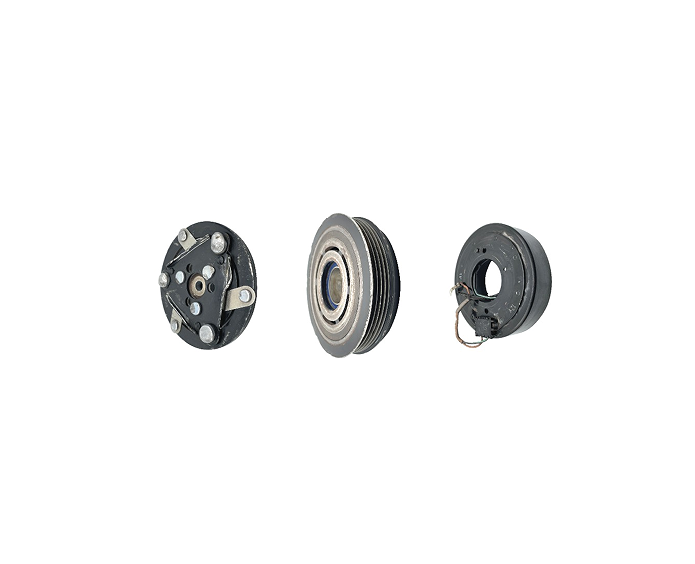
What Is an Automotive AC Compressor Clutch?
An automotive AC compressor clutch is an engagement mechanism used on many belt-driven air conditioning compressors.
The pulley rotates whenever the engine is running and the belt is moving. The compressor itself only receives mechanical power when the clutch engages.
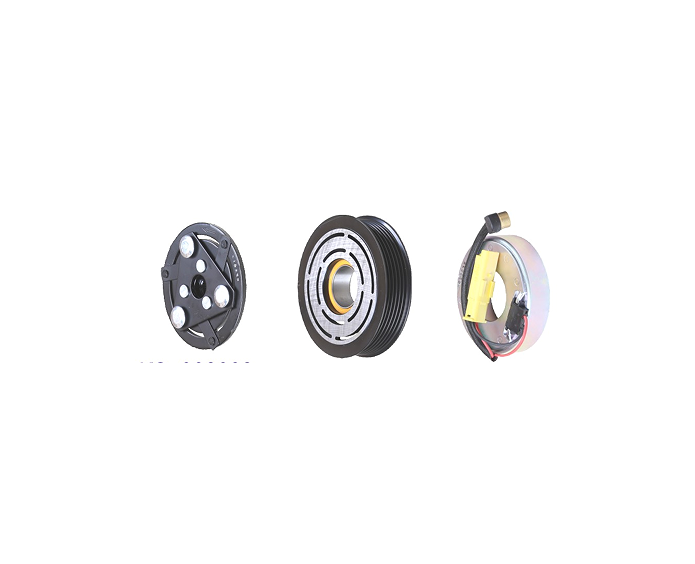
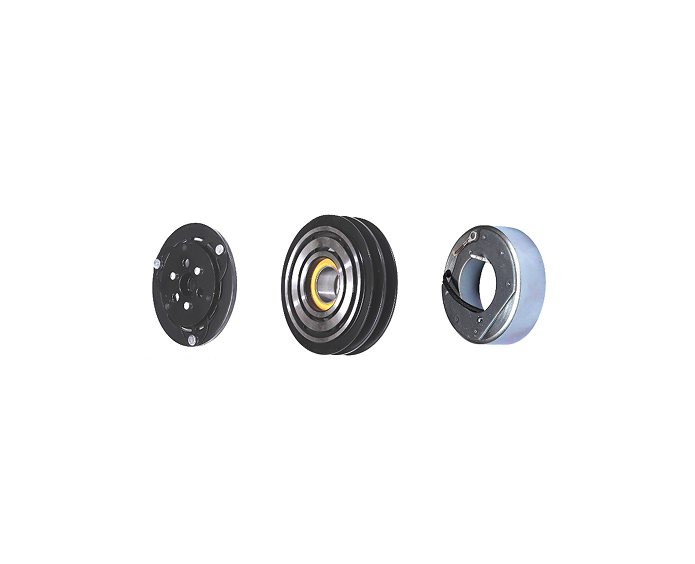
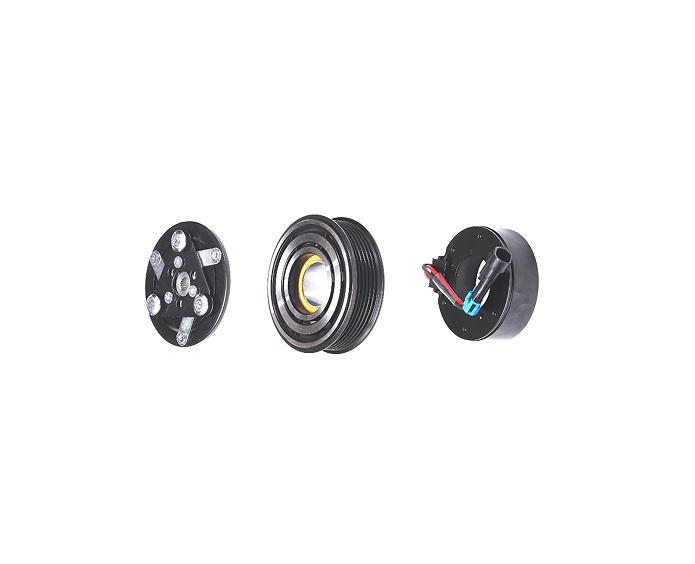
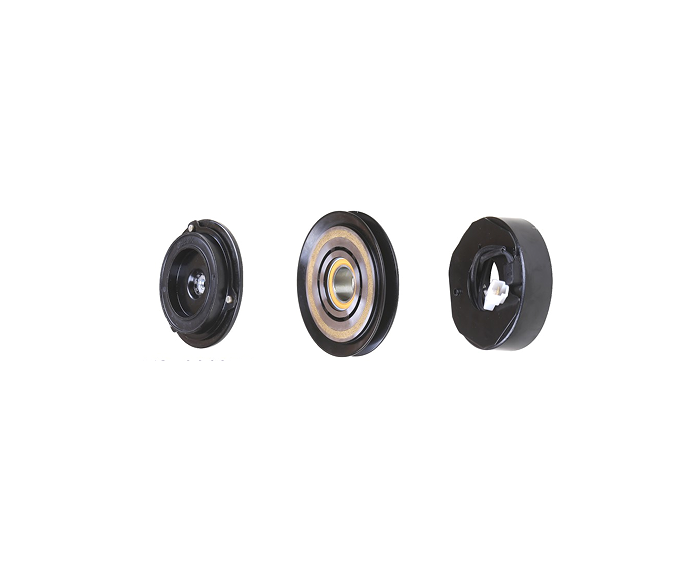
A typical compressor clutch assembly includes several key components:
| Component | Main Function |
|---|---|
| Pulley | Rotates with the engine belt |
| Electromagnetic Coil | Generates magnetic force |
| Hub / Armature Plate | Connects pulley torque to compressor shaft |
| Bearing | Supports smooth pulley rotation |
| Friction Surface | Transfers torque after engagement |
These components must work together within a controlled dimensional and electrical range.
If one component is incorrect, the clutch may:
- Fail to engage
- Slip
- Make noise
- Generate excessive heat
- Wear prematurely
- Damage related compressor components
How Does an Automotive AC Compressor Clutch Work?
The clutch operates through an electromagnetic engagement process.
Step 1: The Pulley Rotates
When the engine is running, the drive belt rotates the compressor pulley.
At this stage, the pulley may rotate while the compressor shaft remains disengaged.
Step 2: The AC System Requests Cooling
When cooling is required, the vehicle control system allows electrical power to reach the clutch coil.
Step 3: The Coil Creates Magnetic Force
The energized coil produces a magnetic field.
This magnetic force pulls the hub or armature plate toward the pulley.
Step 4: The Clutch Engages
Once contact is established, torque from the pulley is transferred to the compressor shaft.
The compressor then begins circulating and compressing refrigerant.
Step 5: The Clutch Disengages
When cooling demand stops or the control system interrupts the signal, the coil loses magnetic force.
The hub separates from the pulley and compressor drive stops.
This engagement-and-disengagement cycle makes clutch accuracy important to compressor reliability.
Main Components Buyers Should Evaluate
Not every compressor clutch assembly has exactly the same geometry, so professional sourcing should look at each critical part separately.
Pulley
The pulley transfers belt rotation.
Important specifications include:
- Outside diameter
- Groove number
- Groove profile
- Width
- Bearing position
A pulley with the wrong diameter or groove configuration may not align correctly with the vehicle belt system.
Electromagnetic Coil
The coil determines whether sufficient magnetic force can be generated for engagement.
Important purchasing factors include:
- Rated voltage
- Coil dimensions
- Connector type
- Winding consistency
- Insulation quality
A coil that physically fits but uses the wrong electrical specification may not perform correctly.
Hub and Armature Plate
The hub transfers torque to the compressor shaft after engagement.
Buyers should confirm:
- Shaft interface
- Hub dimensions
- Plate geometry
- Friction surface condition
Bearing
The bearing supports pulley rotation while the compressor may be disengaged.
Key buyer concerns include:
- Bearing dimensions
- Rotation smoothness
- Noise
- Load capability
- Fit within pulley structure
KASEN also provides related automotive AC bearing products within its broader automotive AC parts range.
Why Air Gap Is Important
The air gap is the clearance between the clutch plate and pulley when the clutch is disengaged.
This small dimension directly affects clutch performance.
If the Air Gap Is Too Large
Possible results include:
- Weak magnetic attraction
- Delayed engagement
- Failure to engage
- Intermittent compressor operation
If the Air Gap Is Too Small
Possible results include:
- Unwanted contact
- Heat generation
- Friction
- Premature wear
For B2B buyers, this is why clutch quality cannot be evaluated only by visual appearance.
Dimensional consistency and assembly accuracy matter across every production batch.
Complete Clutch Assembly vs Individual Compressor Clutch Parts
Different customers require different replacement strategies.
| Purchase Option | Best For | Main Advantage | Main Consideration |
| Complete Clutch Assembly | Distributors, general repair networks | Easier replacement and matching | Higher unit value |
| Coil Only | Specialized repair shops | Lower repair cost | Exact electrical fit required |
| Pulley Only | Pulley or bearing-related repair | Component-level repair | Dimensions must match |
| Bearing Only | Bearing replacement | Low component cost | Skilled installation required |
| Hub / Plate | Specific clutch damage | Avoids full replacement | Precise shaft fit needed |
When a Complete Clutch Assembly Makes Sense
A complete assembly is usually more practical when:
- Several clutch components show wear
- Repair time is important
- The buyer wants simpler SKU management
- Technical matching is easier at assembly level
When Individual Parts Make Sense
Individual parts may be suitable when:
- Failure is clearly isolated
- Skilled repair capability exists
- The compressor body remains functional
- Cost-effective repair is important
KASEN's compressor clutch product range can support buyers comparing clutch-based replacement requirements.
How to Match the Correct Automotive AC Compressor Clutch
Incorrect fitment is one of the largest risks in aftermarket clutch sourcing.
A strong matching process uses multiple data points.
Confirm the Compressor Model
The compressor model is often one of the most useful references.
Two vehicles may use similar AC systems but different compressor families.
The clutch must match the compressor structure.
Verify the OE Reference
OE references help:
- Identify intended application
- Cross-reference replacement products
- Reduce confusion between similar designs
However, OE reference should be combined with physical and compressor data where possible.
Check Vehicle Information
Useful application information includes:
- Vehicle manufacturer
- Model
- Production year
- Engine
- Market or region
Measure Pulley Specifications
Confirm:
- Diameter
- Number of grooves
- Width
- Bearing dimensions
Verify Coil Voltage
Vehicle applications may require different electrical specifications.
Coil voltage and connector configuration should therefore be confirmed before ordering.
Confirm Hub and Shaft Structure
A hub that does not correctly match the compressor shaft can cause installation failure even when pulley dimensions appear correct.
Buyer Matching Checklist
| Information | Why It Matters |
| Compressor Model | Identifies compressor family |
| OE Number | Supports cross-reference |
| Vehicle Model | Confirms application |
| Production Year | Identifies generation differences |
| Engine | Helps separate configurations |
| Pulley Diameter | Belt-system compatibility |
| Groove Number | Belt fitment |
| Coil Voltage | Electrical compatibility |
| Connector | Vehicle connection |
| Bearing Size | Mechanical fit |
| Hub Design | Compressor shaft compatibility |
| Photos | Visual confirmation |
| Physical Sample | Useful for difficult references |
When an application is uncertain, professional buyers should avoid placing large orders until the matching information is confirmed.
Automotive AC Compressor Clutch Applications
Compressor clutches are used across many traditional belt-driven automotive AC applications.
Passenger Cars
Passenger vehicle buyers often prioritize:
- Low noise
- Accurate fitment
- Reliable engagement
- Broad vehicle coverage
- Competitive replacement cost
Commercial Vehicles
Commercial vehicles may operate for longer daily periods.
Important requirements include:
- Durability
- Stable engagement
- Repeat supply
- Maintenance efficiency
Trucks
Truck AC systems may face:
- Long driving cycles
- Greater vibration
- Hot operating environments
- Extended AC usage
For truck distributors, clutch availability can directly influence repair downtime.
Buses
Bus applications often require reliable AC operation over long service cycles.
Fleet maintenance buyers typically value:
- Consistent specifications
- Repeat availability
- Easy identification
- Stable supplier relationships
Common Compressor Clutch Sourcing Risks
Matching by Appearance Only
This is one of the most common errors.
Two clutch assemblies may look almost identical but differ in:
- Pulley diameter
- Groove number
- Bearing
- Coil voltage
- Hub structure
Ordering Before Sample Confirmation
Bulk purchasing without a confirmed sample increases inventory risk.
The approved sample should become a reference for:
- Dimensions
- Electrical specification
- Packaging
- Product identification
Mixing Similar SKUs in the Warehouse
Clear labels are important when several similar clutch models are stocked.
A practical label may include:
- Supplier code
- Buyer SKU
- OE reference
- Compressor model
- Vehicle application
Choosing Only by Unit Price
The cheapest clutch can become expensive when incorrect fitment causes:
- Returns
- Repacking
- Warranty claims
- Reshipping
- Customer complaints
- Dead inventory
Professional buyers should compare total sourcing risk, not only quotation price.
What Quality Factors Should Buyers Check?
Your supplier should be able to explain specific quality controls instead of relying on general statements such as "high quality."
Dimensional Accuracy
Important areas include:
- Pulley dimensions
- Bearing position
- Hub geometry
- Coil dimensions
Coil Performance
Buyers should confirm that electrical specifications remain consistent across batches.
Bearing Condition
A suitable bearing should rotate smoothly and support the intended pulley application.
Pulley Consistency
Pulley geometry affects belt compatibility and rotation.
Assembly Accuracy
Clutch components must be aligned correctly.
Air-Gap Control
A consistent air gap helps support reliable engagement and disengagement.
These details are especially important for distributors managing repeated purchases because a good first sample is not enough if bulk batches vary.
How to Evaluate an Automotive AC Compressor Clutch Supplier
Product Specialization
A supplier familiar with automotive AC components is more likely to understand compressor references, pulley specifications, and clutch applications.
Product Range
Buyers may benefit from sourcing related categories from the same supplier, including:
- Compressor clutches
- Complete compressors
- Bearings
- Electric compressors
- Valves
KASEN's broader automotive AC product catalog covers several of these related categories.
Technical Matching Support
A useful supplier should be able to work with:
- OE numbers
- Compressor models
- Photos
- Drawings
- Samples
- Vehicle information
Repeat-Order Capability
For distributors, the question is not only:
Can this supplier provide one correct clutch?
It is also:
Can the supplier reproduce the same specification six months later?
Packaging and Identification
Private-label and wholesale buyers may require:
- Custom labels
- Brand packaging
- Product codes
- Barcode systems
OEM and Aftermarket Compressor Clutch Programs
OEM and private-label buyers often require stronger product controls than one-time replacement buyers.
OEM Matching
Programs may be based on:
- OE reference
- Compressor model
- Sample
- Drawing
- Technical specification
Private Label
Possible requirements include:
- Customized box
- Product label
- Customer SKU
- Barcode
- Brand identification
Bulk Supply
For larger programs, buyers should confirm:
- Approved specifications
- Batch consistency
- Packaging requirements
- Repeat-order reference
KASEN supports automotive AC component and OEM-related sourcing requirements. Buyers can learn more about the company through the KASEN About Us page.
When Should Buyers Replace the Clutch Instead of the Complete Compressor?
Replacing the complete compressor is not always necessary.
A clutch-focused replacement may be suitable when:
- Compressor internals remain functional
- Failure is isolated to the coil
- Pulley bearing is worn
- Hub or clutch plate is damaged
- Engagement components require replacement
A complete compressor may be more appropriate when there is:
- Internal seizure
- Severe internal wear
- Major leakage
- Internal mechanical damage
For complete compressor requirements, buyers can also review the KASEN auto AC compressor range.
Why KASEN for Automotive AC Compressor Clutch Sourcing?
KASEN focuses on automotive air conditioning components for global aftermarket and OEM-related requirements.
Its product portfolio includes:
- Compressor clutches
- Automotive AC compressors
- Electric compressors
- Bearings
- Valves
- Related automotive AC components
For distributors, wholesalers, repair networks, and aftermarket brands, working with a specialized automotive AC supplier can simplify product matching across related categories.
Buyers can:
- Browse KASEN automotive AC products
- Review automotive AC compressor clutch products
- Explore auto AC compressors
- Learn more about KASEN
- Contact KASEN with OE numbers, compressor models, photos, samples, drawings, quantities, or private-label requirements
Frequently Asked Questions About Automotive AC Compressor Clutches
What is an automotive AC compressor clutch?
An automotive AC compressor clutch is the engagement mechanism that transfers engine-driven pulley rotation to the compressor shaft when the vehicle AC system requests cooling.
What parts are included in a compressor clutch assembly?
A typical assembly can include the pulley, electromagnetic coil, bearing, hub or armature plate, and related mounting components.
How do I identify the correct compressor clutch?
Confirm the compressor model, OE reference, vehicle application, pulley diameter, groove number, coil voltage, bearing dimensions, and hub design.
Can two compressor clutches look the same but be incompatible?
Yes. Similar-looking clutches can have different pulley dimensions, bearings, voltages, connectors, or hub structures.
Can I replace only the clutch instead of the complete compressor?
In some applications, yes. If the compressor internals remain functional and the fault is isolated to the clutch, component-level replacement may be more practical.
What is the most important clutch specification for distributors?
There is no single specification. Reliable matching normally requires compressor model, pulley dimensions, coil specification, bearing size, hub design, and OE/application information.
Why does clutch air gap matter?
Air gap influences engagement. Excessive clearance may prevent reliable engagement, while insufficient clearance can cause unwanted friction and wear.
Should I buy a complete clutch assembly or separate components?
Complete assemblies simplify replacement and SKU management. Individual coils, pulleys, bearings, or hubs may be more suitable for specialized repair markets.
Can KASEN support OEM or private-label compressor clutch requirements?
KASEN supports automotive AC sourcing and OEM-related requirements. Buyers can provide OE references, compressor information, samples, drawings, and packaging requirements for evaluation.
How can I request an automotive AC compressor clutch quotation?
Send your compressor model, OE number, vehicle application, pulley specifications, quantity, photos, sample information, and packaging requirements through the KASEN contact page.
Conclusion
Choosing the right automotive AC compressor clutch requires much more than finding a visually similar replacement.
Professional buyers should verify compressor models, OE references, vehicle applications, pulley dimensions, groove configurations, coil voltage, bearings, hub structures, and air-gap requirements before placing bulk orders.
For distributors and aftermarket brands, sample approval, product identification, batch consistency, and reliable repeat supply are equally important because one incorrect clutch reference can create returns and dead inventory across an entire purchasing batch.
KASEN provides automotive AC compressor clutches alongside compressors, electric compressors, bearings, valves, and related components for global sourcing requirements.
Explore the KASEN compressor clutch range or contact KASEN with your OE references, compressor models, technical data, samples, and bulk purchasing requirements.