
MIMS 2026: What Auto Buyers Should Look for in Compressor Clutches

  • news
Posted by Guangzhou Kasen Auto Air Conditioner CO.,LTD On Aug 21 2026

Why MIMS 2026 matters for buyers watching the auto aftermarket

mims 2026

MIMS 2026 will be more than a date on the trade-show calendar for anyone sourcing automotive air-conditioning components. For engineers, purchasing teams, and rebuild shops, the real question is not whether the halls will be busy; it is whether the suppliers on the floor can support the kind of compressor clutch demand that keeps workshops moving through the summer and keeps stock from aging on the shelf. In a market where small electromechanical parts can decide whether a repair is finished the same day or pushed into another week, MIMS 2026 is the sort of event that helps buyers compare options quickly and with fewer surprises.

That is especially true for compressor clutches. They sit at the point where mechanical drive, electrical control, and wear resistance all meet. If the clutch slips, binds, runs noisy, or simply does not match the compressor family, the whole A/C repair can become more expensive than the vehicle owner expected. Buyers coming to the MIMS exhibition 2026 will likely be looking for a supplier who can show consistent construction, practical product range, and enough manufacturing discipline to support repeat orders.


What the product family suggests about the supplier

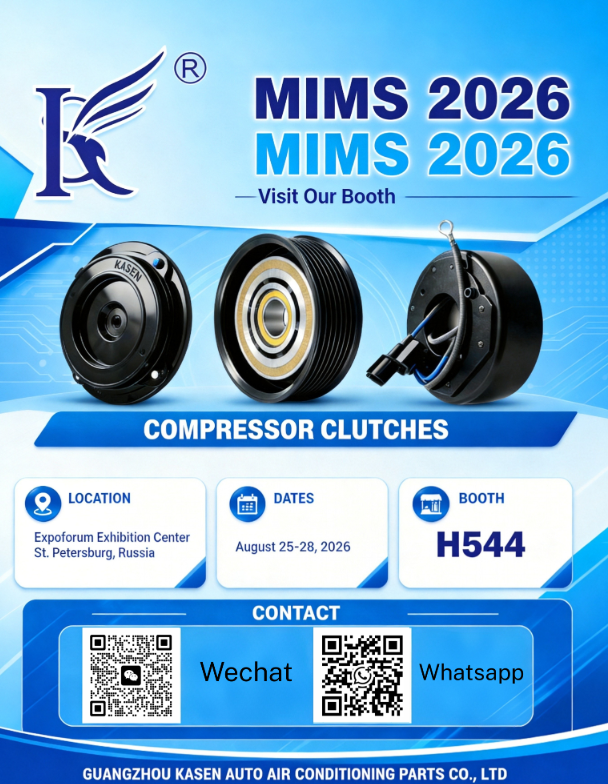
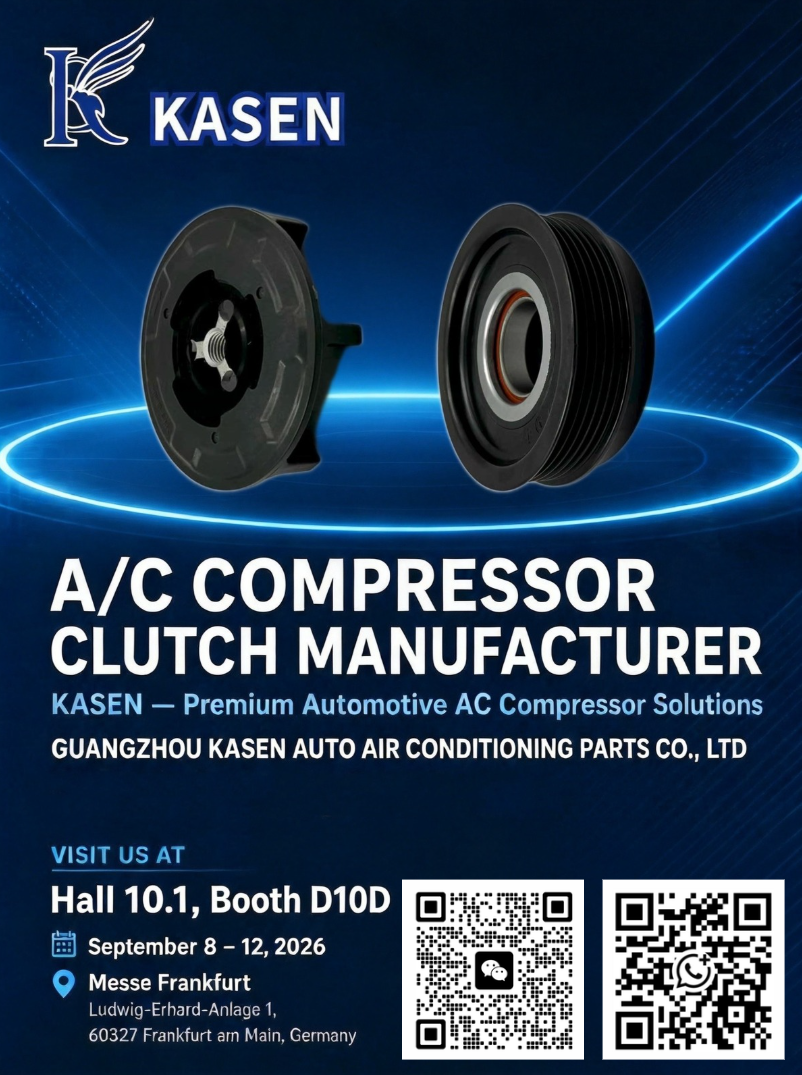
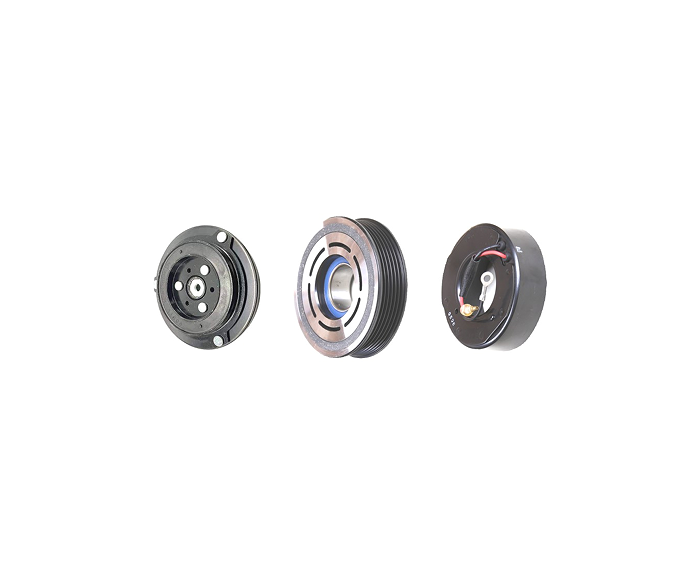
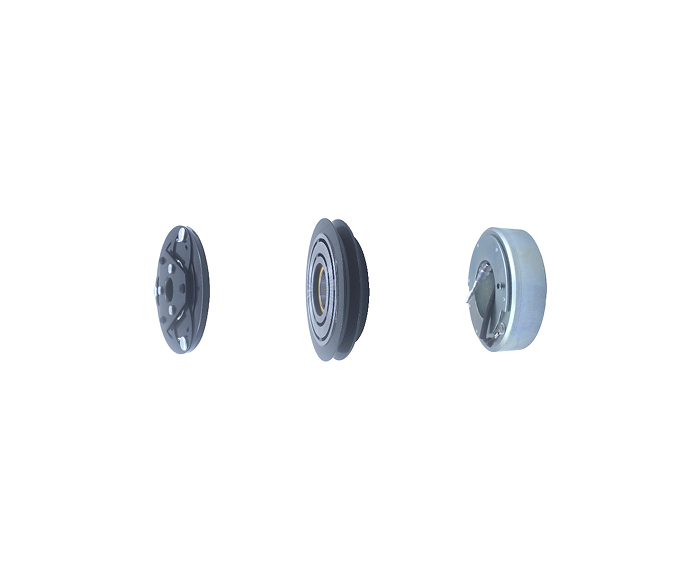
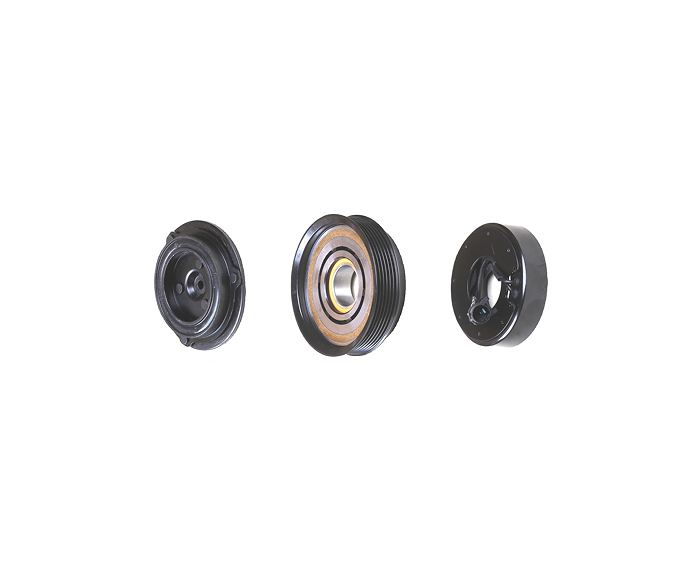
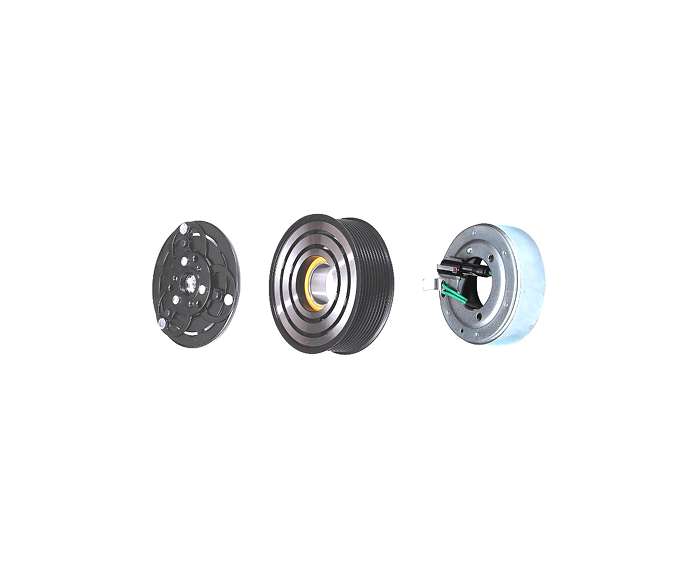
The product information points to automotive compressor clutches for air-conditioning compressors, with a visible family of round, flat-faced assemblies. The units shown include a ribbed pulley with a visible bearing race, a front clutch plate or hub with mounting holes, and a rear coil or connector side with wiring leads and a lifting eye. That mix matters. It suggests the supplier is not offering only a single generic part, but a broader clutch family that may cover different compressor configurations or service needs.

Guangzhou Kasen Auto Air Conditioning Parts Co., Ltd. is identified in the branding, and the visible construction tells a familiar story for this type of component: machined steel or iron parts, black coated surfaces, exposed bearing surfaces, and electrical features integrated into the rear assembly. That is the kind of product where visual simplicity can hide a lot of engineering detail. A buyer can see the housing and pulley, but the important questions sit underneath: bearing quality, coil reliability, fit consistency, and coating durability.


What buyers should compare at the show

If you are evaluating compressor clutches at MIMS 2026, start with fit and functional range before price. The useful suppliers are usually the ones who can explain which compressor families they serve, whether they support front clutch/pulley assemblies as well as coil-side versions, and how they handle differences in mounting pattern or connector style. The product images suggest multiple clutch variants within one family, which is a positive sign for aftermarket and rebuild buyers, but it is not the same as verified OEM interchangeability.


Practical points worth checking

Ask how the bearing is installed and what inspection happens before shipment. Ask whether the coil lead and connector style can be matched to common service requirements. Ask what surface coating is used and how the company controls corrosion on the exposed metal areas. Those are not academic questions; they are the ones that decide whether a part survives storage, shipping, and daily use in a hot engine bay.

Also, do not assume that every round clutch assembly on the table is interchangeable. Compressor clutches are easy to confuse visually, and that is where buyers get burned. Two parts can look close enough in a booth and still differ in hub geometry, pulley profile, or electrical interface. A good supplier should expect those questions and answer them without hand-waving.


Why this product category is attractive to distributors and rebuilders

For auto repair shops and compressor rebuilders, compressor clutches are a practical stock item because they sit in a steady repair category. Air-conditioning failures are common enough to justify inventory, but not so uniform that a one-size-fits-all strategy works well. That makes a supplier with multiple clutch configurations useful. It can reduce sourcing friction when a workshop needs to match a specific compressor without waiting through a long back-and-forth.

For distributors, the appeal is slightly different. Product families with visible variation make it easier to build a service range, but only if the supplier can keep the identification system clear. Otherwise, the catalog gets messy fast. At a show like MIMS exhibition 2026, the best conversations often happen around labeling, application data, and how the seller helps buyers avoid ordering the wrong clutch.


Common mistakes buyers should avoid

The biggest mistake is treating a compressor clutch like a simple commodity. It is not. It has a mechanical wear path, an electrical side, and a matching requirement that can be surprisingly unforgiving. Another common error is focusing on appearance instead of service fit. A black coated housing and clean machining are reassuring, but they do not replace specification data.

A more subtle mistake is ignoring the support side of the product. If a supplier cannot clearly explain variant differences, packaging, or part identification, that friction usually shows up later in returns and field complaints. In aftermarket buying, that kind of hidden cost is often more painful than a slightly higher unit price.


Questions to ask before placing an order

Before you move past the booth discussion, ask for the application range, the available clutch variants, and the documentation that supports selection. If the supplier can provide clear product grouping, assembly details, and basic identification information, that is a stronger sign than any sales pitch. For parts like these, clarity is part of quality.

If you are planning sourcing around MIMS 2026, it may also be worth requesting samples or cross-reference data early, especially if your business handles mixed vehicle fleets or rebuild work. The right supplier should make that process easier, not more complicated.


What to do next

Use MIMS 2026 to compare clutch construction, variant coverage, and supplier responsiveness in one visit. If Guangzhou Kasen Auto Air Conditioning Parts Co., Ltd. is on your list, bring application questions and make the supplier prove fitment logic, not just show you polished hardware. That is usually where the real buying decision gets made.

Featured Blogs
Automechanika Frankfurt Guide for A/C Compressor Clutch Buyers

Automechanika Frankfurt Guide for A/C Compressor Clutch Buyers

1. Why Automechanika Frankfurt still matters to A/C component buyers 2. What the KASEN clutch components suggest about the product category 3. Quick buyer takeaways from a trade fair visit 4. Why compressor clutch quality affects the repair business 5. What to ask a supplier on the stand 6. Common mistakes buyers make with A/C clutch parts 7. Using Automechanika Frankfurt as a sourcing filter 8. Next step for buyers and distributors

MIMS 2026: What Auto Buyers Should Look for in Compressor Clutches

MIMS 2026: What Auto Buyers Should Look for in Compressor Clutches

1. Why MIMS 2026 matters for buyers watching the auto aftermarket 2. What the product family suggests about the supplier 3. What buyers should compare at the show 4. Why this product category is attractive to distributors and rebuilders 5. Common mistakes buyers should avoid 6. Questions to ask before placing an order 7. What to do next

Understanding Tribology in Auto AC Clutch Systems

Understanding Tribology in Auto AC Clutch Systems

Tribology plays an important role in auto AC clutch performance by controlling friction, wear, lubrication, and surface interaction. This article explains how tribology affects an automotive air conditioner clutch and what buyers should evaluate when sourcing durable replacement parts.

Understanding the Relationship Between Speed and AC Clutch Wear

Understanding the Relationship Between Speed and AC Clutch Wear

Rotational speed has a direct impact on auto AC clutch wear. This article explains how speed affects friction, bearing load, heat generation, component fatigue, and service life in an automotive air conditioner clutch.

Pressure Distribution in Auto AC Clutch Friction Plates

Pressure Distribution in Auto AC Clutch Friction Plates

Pressure distribution plays a critical role in auto AC clutch friction plate performance. This article explains how contact pressure affects torque transfer, wear patterns, heat generation, and durability in an automotive air conditioner clutch.

The Role of Fillers in AC Clutch Friction Material Formulation

The Role of Fillers in AC Clutch Friction Material Formulation

Fillers play an important role in AC clutch friction material formulation. This article explains how fillers influence friction stability, heat resistance, wear control, noise, and long-term durability in an automotive air conditioner clutch.